
Zarguzasht by Mushtaq Ahmad Yousufi – Complete PDF Download
novelbazar.com
✅ Complete PDF Download
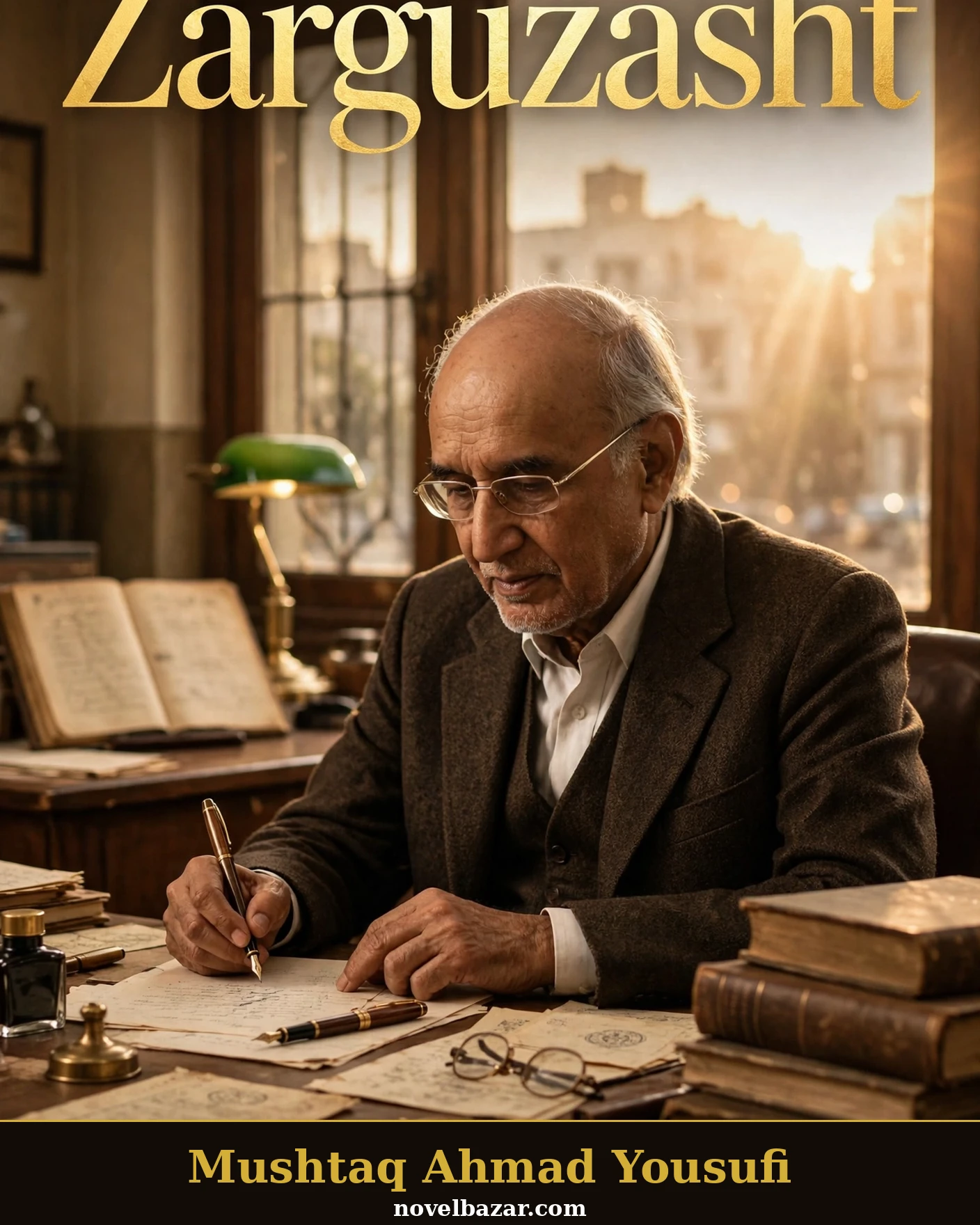
Zarguzasht by Mushtaq Ahmad Yousufi is one of the most celebrated books in Urdu literature, and one of the most misunderstood by searchers. People look for it as a “novel”, but it is not a conventional novel at all. There is no fictional hero and heroine, no love story, and no invented plot to summarise. Zarguzasht is a satirical, humorous autobiographical work: a collection of essays and sketches in which Yousufi turns his own life, above all his long career in banking, into comedy. First published in 1976, it is often described as Yousufi’s best work, and once you understand what kind of book it is, it is easy to see why it has stayed in print and in conversation for fifty years.
Quick Answer: Zarguzasht (1976) by Mushtaq Ahmad Yousufi is a humorous autobiography and collection of satirical sketches, not a fictional novel. It draws its comedy from the author’s real working life in banks, his colleagues, and the everyday absurdities of office and city life. On NovelBazar you can read it online and download the complete PDF using the buttons above.
| Book Name | Zarguzasht (زرگزشت) |
| Author / Writer Name | Mushtaq Ahmad Yousufi |
| Genre | Satire, Humour, Autobiographical Essays and Sketches |
| First Published | 1976 |
| Status | Complete Book |
| Language | Urdu |
| Availability | Read Online and Complete PDF Download |
Zarguzasht by Mushtaq Ahmad Yousufi: What This Book Really Is
The first thing to settle is the genre, because almost every short listing on the internet gets it slightly wrong by calling Zarguzasht a novel and then failing to give any story. The book’s own character is different. Yousufi builds the book on himself, as he puts it in his own preface, and the material is his lived experience: the offices he worked in, the colleagues he watched closely, the formal world of banking with all its rules, hierarchies and small vanities, and the ordinary incidents of life in Karachi. The comedy does not come from invented twists. It comes from observation: a small oddity of behaviour, noticed sharply, isolated, and magnified until it becomes funny, and then, a moment later, quietly sad or true.
That is why Zarguzasht reads so differently from a novel. You do not follow one storyline from beginning to end. You move through sketches and essays, each complete in itself, each returning to the same world from a new angle. A reader can open the book anywhere, read one piece, and close it satisfied. That episodic shape is also the honest answer to anyone asking for “the story of Zarguzasht”: there is no single story, and any page that invents one is inventing, not summarising.
What Does Zarguzasht Mean?
The title itself is a joke, and understanding the joke is the fastest way into the book. The Urdu word for autobiography is Sarguzasht. Yousufi changes one letter and gives us Zarguzasht, a play on that word that has been rendered in English as “Lost Treasure”. The title promises a life story, and then immediately tells you, with a wink, that this life story will not behave like a solemn autobiography. It will be a treasure hunt through memory, but the treasure is comedy: the remembered phrases, postures and pretensions of real people, preserved with affection rather than malice.
Zarguzasht Book Summary: The Banking World and Its People
At theme level, and without inventing any episode beyond what published profiles report, this is what the book contains. The centre of the book is Yousufi’s professional life. He joined Muslim Commercial Bank in 1950 and went on to work for Allied Bank and United Bank, eventually becoming chairman of the Pakistan Banking Council in 1977. The offices, the interviews, the bosses, the clerks, the office boys, the files and the formalities of that world supply the book’s cast. Academic writing on Zarguzasht describes exactly this: Yousufi makes the habits and qualities of his banking colleagues, and their natural attitudes and tendencies, the subject of his writing, looking at their strengths and their follies with the same even eye.
One reported opening scene sets the tone for the whole book, and it is worth knowing before you start. The book begins with the author’s interview for his first banking job, where he meets his boss, Mr Anderson. Anderson’s first questions are famously blunt: “How are you? Who are you? What are you? And why are you?” Asked which family he belongs to, the young Yousufi answers simply, “From my own family”, and Anderson thanks him for his honesty. That exchange, frank, absurd and completely believable, is Yousufi’s method in miniature: take a real encounter, keep its exact flavour, and let the comedy speak for itself.
A second feature of the book’s world is its range of reference. Yousufi’s prose is famously studded with Persian and Urdu verse and with quotations from writers such as Shakespeare, John Donne, Marcel Proust, Rudyard Kipling and Mark Twain, alongside anecdotes from ancient China, Greece, and classical Persian and Arabic literature. A bank anecdote can therefore open out, in a sentence or two, into a literary or philosophical aside, and then snap back to the office with a punchline. Readers who love that layered style call it the peak of Urdu humour writing. Readers new to classical Urdu should be warned, honestly, that the vocabulary can be demanding, and the book is best read slowly, one sketch at a time.
Mushtaq Ahmad Yousufi: The Author Behind the Book
Mushtaq Ahmad Yousufi was born on 4 September 1923 in Tonk, Rajasthan, then in British India, into a well-educated family. His father, Abdul Karim Khan Yusufi, was Speaker of the Jaipur Legislative Assembly. Yousufi studied at Agra University and then at Aligarh Muslim University, where he completed an M.A. in Philosophy and an LL.B. After Partition his family migrated to Pakistan, where his banking career and his writing life ran side by side for decades, an unusual double career that no other major Urdu humourist matched.
His books, in order, tell the story of that double life: Chiragh Talay (1961), his first book, which established him at once as a humorist of the first rank; Khakam Badahan (1969), a collection of essays; Zarguzasht (1976); Aab-e-Gum (1990), his later, longer work, eventually translated into English as Mirages of the Mind; and Sham-e-Shair-e-Yaaran (2014), his final book. The honours that followed tell the same story as the sales: the Sitara-e-Imtiaz in 1999 and the Hilal-e-Imtiaz in 2002, and the Pakistan Academy of Letters’ Kamal-e-Fun Award in 1999. Fellow satirist Ibn-e-Insha said that if Urdu literary humour of the time could be given a single name, it would be Yusufi’s. Obituaries after his death in Karachi on 20 June 2018 called him the Mark Twain of Urdu literature. Yousufi himself described humour, in a preface, as a “wall of laughter” between man and the bitter facts of life, and Zarguzasht is that idea put into practice: laughter that does not hide the bitter facts, but makes them bearable and visible.
Why Zarguzasht Is Called Yousufi’s Best Work
Three reasons recur in serious writing about the book. First, the material is the author’s own, so the observation has an authority that invented comedy cannot fake. Second, the targets are follies and systems, not individuals to be humiliated, which is why the book has stayed affectionate rather than dated or cruel. Third, the prose itself is the performance: the wordplay, the verse quotations, the sudden philosophical aside, the meticulous rewriting for which Yousufi was known. He was a famously careful editor of his own work, drafting and redrafting until the sentence sounded effortless. That effortlessness is what new readers notice first, and what experienced readers admire most.
There is also a useful distinction to keep straight. Aab-e-Gum, Yousufi’s 1990 book, is the one with Basharat and his family, the Partition journey from Kanpur to Karachi, and the English translation. Those characters and that story belong to Aab-e-Gum, not to Zarguzasht, and any summary that moves them across is confusing two different books. Zarguzasht’s world is the author’s own office and memory, and its people are his colleagues, bosses and acquaintances, sketched as themselves.
Who Should Read Zarguzasht, and How to Read It
Zarguzasht suits readers who enjoy sharp, literate comedy, readers interested in old Karachi and in the vanished world of mid-century office life, and readers who already love Urdu prose and want to read its acknowledged master at his best. It is also an excellent first Yousufi book for a confident Urdu reader, because its sketches are self-contained. If your Urdu is still developing, start with Chiragh Talay and treat Zarguzasht as the second step, or read Zarguzasht in short sittings with a dictionary nearby, and do not be discouraged by an unfamiliar word: even experienced readers pause over Yousufi’s vocabulary, and the joke usually survives the pause.
Read it as you would a book of essays, not a novel. Read one sketch, let it settle, and come back the next day. Notice the small details: the exact phrase a colleague uses, the formality that hides a vanity, the quotation that quietly changes the meaning of the paragraph before it. That slow reading is how the book was written, over years of drafting, and it is how it repays attention.
Key Facts
- Zarguzasht is a satirical autobiography and sketch collection, first published in 1976, not a fictional novel.
- Its comedy comes from Yousufi’s banking career and his colleagues, observed with affection and a detached eye.
- The title plays on Sarguzasht (autobiography).
- Yousufi is often called the Mark Twain of Urdu literature; Ibn-e-Insha named him as the name of Urdu literary humour of his time.
- Do not confuse it with Aab-e-Gum (1990), the later book translated as Mirages of the Mind.
| Book Name | Zarguzasht |
| Writer | Mushtaq Ahmad Yousufi |
| Genre | Urdu Satire and Humour, Autobiography |
| Format | Complete Book PDF |
| Title Meaning | A play on Sarguzasht (autobiography); rendered as “Lost Treasure” |
| Common Theme | Office life, colleagues, memory, and the comedy of everyday formality |
| Language | Urdu |
| Status | Complete |
| Reading Format | Read Online or Download PDF |
Read or Download Zarguzasht by Mushtaq Ahmad Yousufi
Use the buttons at the top of this page to read Zarguzasht by Mushtaq Ahmad Yousufi online or download the complete PDF. The buttons use the owner-supplied download link for this book.
Frequently Asked Questions
Is Zarguzasht a novel?
No. Although it is often listed under “novel” in search results, Zarguzasht is a satirical autobiography and collection of humorous essays and sketches. It has no invented fictional plot, hero or heroine.
Who wrote Zarguzasht?
Mushtaq Ahmad Yousufi, the Pakistani Urdu satirist and humourist, banker, and recipient of the Sitara-e-Imtiaz and Hilal-e-Imtiaz.
When was Zarguzasht first published?
The first edition was published in 1976, between Khakam Badahan (1969) and Aab-e-Gum (1990).
What is Zarguzasht about?
At theme level, it is about Yousufi’s own life, above all his banking career: his colleagues, his bosses, office formalities, and everyday incidents, turned into satirical sketches. The reported opening scene is his first banking job interview with his boss, Mr Anderson.
What does the title Zarguzasht mean?
It is a play on Sarguzasht, the Urdu word for autobiography, and is often rendered in English as “Lost Treasure”.
Is Zarguzasht complete?
Yes. The complete book is offered here. Use the Read Online or Download PDF buttons above.
Is there an English translation of Zarguzasht?
No widely known English translation of Zarguzasht is established, and Intizar Husain famously remarked that Yusufi’s work is “untranslatable”. The Yousufi book translated into English as Mirages of the Mind is the later Aab-e-Gum, not Zarguzasht.
Which Mushtaq Ahmad Yousufi book should I read first?
Confident Urdu readers can start with Zarguzasht itself, since its sketches stand alone. Newer readers often start with the shorter first book, Chiragh Talay (1961), and then move to Zarguzasht.
More Books You Will Love
Explore more complete books free on NovelBazar:
- Doraha by Umera Ahmed – Complete PDF Download
- Main Abdul Qadir Hoon by Sarwat Nazeer – Complete PDF Download
- Wo Jo Qaraz Rakhte The Jan Par by Farhat Ishtiaq – Complete PDF Download
Final Verdict
Zarguzasht by Mushtaq Ahmad Yousufi is not a novel to be read for a plot, and that is exactly its strength. It is a life remembered with wit: a banker’s offices, colleagues and everyday absurdities, shaped by one of Urdu’s greatest prose stylists into sketches that are funny on first reading and truer on the second. If you want to understand why Yousufi is called the Mark Twain of Urdu literature, this is the book to start with. Read it online or download the complete PDF using the buttons above, and read it slowly, one sketch at a time.


