
Khaak aur Khoon by Naseem Hijazi – Complete PDF Download
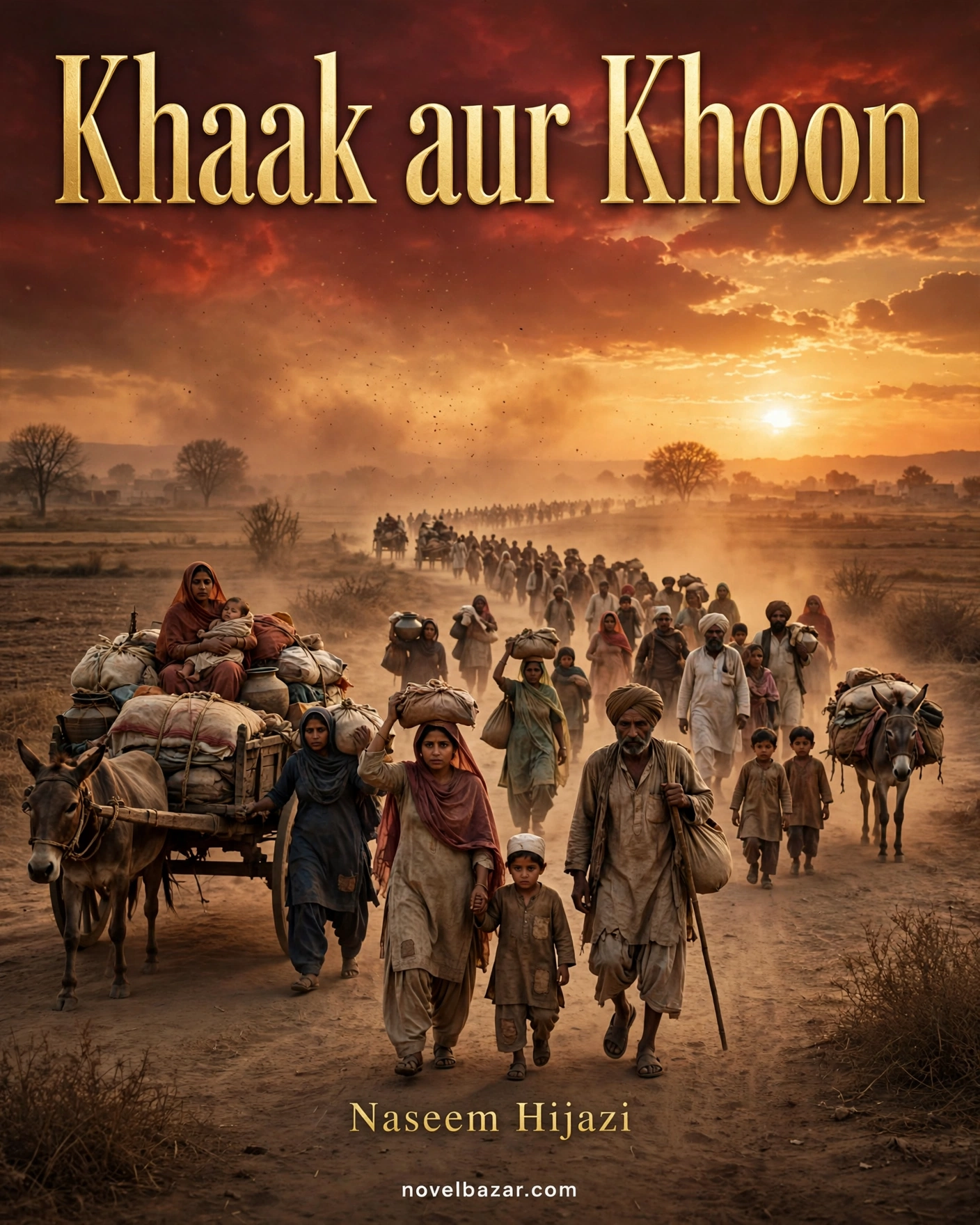
novelbazar.com
Khaak aur Khoon by Naseem Hijazi is one of the most widely read Partition novels in Urdu, and this page gives you the complete novel to read online and download as a PDF, together with the summary, characters, themes and film history that other download pages leave out or get wrong.
First published in 1950, only three years after Partition, it tells the story of a generation that paid for a homeland with everything it owned, and in many cases with its life.
The title itself tells you what kind of book this is.
Khaak means dust or soil, and Khoon means blood.
In English the title is usually translated as “The Dust and the Blood”.
It is not a light romance with a historical backdrop.
It is a historical novel about 1947, about a village in East Punjab, a joint family, a young man who joins a political cause, and a migration journey that destroys almost everything he loves and still leaves him standing.
Readers who come to it expecting a love story will find love in it, but love is not what drives the book.
Sacrifice is.
One warning before you start, because it saves confusion later.
Some popular download pages describe this book as a story about Muslims expelled from Spain under Isabella and Ferdinand.
That is wrong.
That is the subject of some of Naseem Hijazi’s other historical novels, not this one.
Khaak aur Khoon is set in the Punjab of 1947, in the months around Partition, and everything in the summary below follows that setting, which is confirmed by the novel’s reference summaries and by its 1979 film version.
Quick Answer: Khaak aur Khoon by Naseem Hijazi is a complete 1950 Urdu historical novel about Partition in 1947.
It follows Saleem, a Tahsildar’s son from East Punjab, from childhood and Muslim League work at college through the migration in which his family is martyred, to survival, service to migrants, and marriage to Asmat.
Read it online or download the complete PDF using the buttons below.
| Novel Name | Khaak aur Khoon |
| Author / Writer Name | Naseem Hijazi (Sharif Hussain) |
| Genre | Historical novel (Partition, 1947), not a romance |
| First Published | 1950, Pakistan |
| Status | Complete novel |
| Language | Urdu |
| Availability | Free PDF Download and Read Online |
| Film Adaptation | 1979 film, directed by Masood Parvez, 8 Nigar Awards |
Key Facts
- Title meaning: “The Dust and the Blood”.
- Hero: Saleem, a Tahsildar’s son from East Punjab.
- Setting: Punjab before and during Partition, 1947.
- Structure: childhood and political awakening, then migration and loss.
- Ending: marriage to Asmat, and Majeed at the Kashmir front.
- Genre warning: historical novel, not a romantic novel, and not set in Spain.
Khaak aur Khoon Novel by Naseem Hijazi: Complete Story Summary
The novel follows one life from childhood to the founding of Pakistan, and it is built in two clear parts.
The first part is about growing up.
The second part is about losing almost everything and choosing to keep going anyway.
That two-part shape is the key to the whole book, and it is why the ending feels earned rather than simply sad.
Saleem, the protagonist, is the son of a Tahsildar, a local revenue officer, and he belongs to an influential yet virtuous joint family in a village in East Punjab.
The early chapters stay close to his childhood: a boy who is bright at his studies and at sports, brought up with strong values, first educated in his village school.
Nothing in this opening suggests tragedy.
It reads like the portrait of a settled, respected household, and that calm is deliberate.
Hijazi wants you to know what was lost before he shows you the losing of it.
Saleem then goes to college for further studies, and there his life changes direction.
He meets young, enthusiastic workers of the All India Muslim League who are working for an independent state, and their cause becomes his aspiration.
He does not join as a bystander.
He throws himself into it, speaks for it, and goes, in the novel’s phrase, to the last extent for it.
For a modern reader, this is the most important passage in the book to read slowly, because it explains everything that follows.
Saleem’s politics are not an opinion he holds.
They are the commitment around which his adult life is organised.
Then comes Partition, and the novel changes completely.
After Pakistan is established, the story becomes the story of the Muslim migrants and what they suffered on the journey.
Saleem’s village community sets out, and in a ferocious armed combat between the Muslims of his village and Sikh militants, Saleem’s whole family is martyred despite fighting selflessly.
It is the central catastrophe of the novel, and Hijazi does not soften it.
A family that the reader has known since Saleem’s childhood is gone in the violence of migration.
Saleem survives, and survival is not presented as luck or as a happy turn.
He goes on with the cause and spends himself helping other migrants through the same painful journey that killed his family.
The novel’s moral centre is here, in this refusal to turn grief into bitterness or retreat.
He helps strangers make the journey that his own family did not complete.
The ending is emotional rather than triumphant.
Saleem marries Asmat, the girl he has loved since his school days, and the novel closes with Majeed leading a battalion to the Kashmir front, while Saleem feels deeply grateful and content with his contribution to the establishment of Pakistan.
Grief and gratitude sit side by side in that final note, and that mixture is the book’s real subject.
Pakistan, in Hijazi’s telling, was not received.
It was paid for, in dust and in blood, and the people who paid for it knew the price and still counted the cause worth it.
Readers who enjoy this kind of classic Urdu storytelling may also like Zarguzasht by Mushtaq Ahmad Yousufi.
The Real History Behind Khaak aur Khoon: Partition 1947
Khaak aur Khoon is historical fiction, not a history textbook, but it is anchored in real events that a new reader should understand before judging the novel.
In 1947 British India was divided into India and Pakistan, and millions of people crossed the new borders in both directions.
In Punjab the migration turned violent on a terrible scale, with caravans attacked, villages emptied, and families separated or destroyed.
The novel’s migration chapters draw on that collective experience, and readers in Pakistan have long read the book as a memorial to it.
One episode the novel’s background material stresses is the fate of Gurdaspur.
On 3 June 1947, Lord Mountbatten announced that the Punjab district of Gurdaspur was to be aligned with Pakistan.
According to the novel’s account, Muslims in the area then guarded the homes and properties of their non-Muslim neighbours from rioting.
But the Radcliffe award that finally drew the boundary gave Gurdaspur to India, which the novel presents as giving India a land passage to Kashmir, whose ruler Hari Singh wanted accession to India.
Readers should know that this is the novel’s perspective on a contested boundary decision, and historians still debate the Radcliffe award.
What matters for reading the book is that Hijazi treats Gurdaspur as a symbol: a promise that seemed certain, and then a line on a map that changed who lived and who had to leave.
The other historical fact the novel keeps returning to is the vulnerability of the migrant caravans.
People travelling to Pakistan were attacked on the road and robbed of money and of women’s jewellery.
The novel does not treat this as background colour.
The road itself, the dust, the slow caravan, the fear of attack, becomes the central image of the second half, and it is where the title earns its meaning.
Khaak is the dust of that road.
Khoon is what was spilled on it.
Main Characters in Khaak aur Khoon
Saleem.
The protagonist and the novel’s moral centre.
A Tahsildar’s son from a respected joint family, bright at academics and sports, raised with strong values, then a college student and Muslim League worker who gives his adult life to the cause of an independent state.
His arc runs from a sheltered childhood, through political awakening, through the martyrdom of his family, to a grief that turns into service to other migrants rather than despair.
If you remember one character from this book, it is Saleem, because the novel is, in structure, his life.
Asmat.
The girl Saleem has loved since his school days, and the sister of his school friend Amjad.
She is not a heroine in the romantic-novel sense, with her own long subplot.
Her importance is quieter and, for this book, more powerful.
She represents continuity: the life Saleem hoped for before Partition, the home he can still build after it, and the fact that love survives a catastrophe without cancelling it.
Their marriage at the end is not a reward tacked on to a tragedy.
It is the novel’s statement that a future is still possible.
Amjad.
Saleem’s school friend, and Asmat’s brother.
He links Saleem’s two worlds, the schoolboy world of friendship and the adult world of marriage and family.
Some film summaries describe Amjad as Saleem’s cousin, while the novel summary describes him as a school friend; this draft follows the novel wording, and the difference is a reminder to treat film and novel details as related but not identical.
Majeed.
The figure who carries the novel’s closing image, leading a battalion to the Kashmir front.
He stands for the generation that did not stop at Partition but went on to defend the new state, and his departure closes the book on a note of duty rather than rest.
The joint family.
Treated as a character in its own right.
The novel spends its first part making you know this household, its standing, its values, its togetherness, so that its destruction in migration is not a statistic but a loss you feel.
That is Hijazi’s method throughout: he gives you a home, then he shows you what it cost to leave it.
Themes in Khaak aur Khoon by Naseem Hijazi
Sacrifice.
The novel’s first and largest theme.
Every gain in the book has a price, and the price is usually paid by ordinary people, not by leaders.
Saleem’s family, the migrants on the road, and the villagers who fight rather than flee all embody the idea that a homeland was bought, not granted.
Migration and exile.
Leaving home is not a journey in this novel.
It is an uprooting.
The caravan chapters, the dust, the attacks, and the slow, fearful road to Pakistan form the book’s most famous passages, and they are why the novel is still read at school and college level in discussions of Partition literature.
Identity and belonging.
Saleem’s college years ask a question the whole novel keeps asking: what makes a people a nation, and what does a person owe to that identity?
His answer is total commitment, and the novel tests that answer against the worst possible outcome, the death of his family, and still holds it.
Unity as a warning.
Hijazi closes his argument, in the novel’s own terms, with a warning to later generations: if Pakistani Muslims want to keep their homeland safe, they must stay united.
Modern readers may agree or argue with that message, but no honest summary can leave it out, because it is the lesson the novel itself draws from 1947.
Love inside history, not instead of it.
Saleem and Asmat’s love matters, but it never displaces the historical story.
This is the clearest way to tell a historical novel from a romance, and it is why readers looking for a romantic novel should adjust their expectations before starting.
The romance here serves the history, not the other way round.
Grief that becomes service.
After his family’s martyrdom, Saleem does not withdraw.
He helps other migrants.
The novel’s quiet argument is that the proper response to loss is not revenge alone, and not despair, but work for the people still on the road.
For another powerful family story from classic Urdu literature, see Aangan by Khadija Mastoor.
Is Khaak aur Khoon a Romantic Novel? A Genre Correction
No, and this matters for search results as much as for reading.
Many download pages file every Urdu novel under romance by default, and some even describe this book with a Spanish setting that belongs to other Hijazi novels.
Khaak aur Khoon is a historical novel about Partition.
Its genre, in reference sources, is listed plainly as “historical novel”, and its subject is the sacrifices of Muslims of the subcontinent in 1947.
It contains a love story, Saleem and Asmat, but the book’s engine is politics, migration, violence and nation-building, not courtship.
If you want a Hijazi romance in the usual sense, this is not it.
If you want to understand why Partition still shapes how Pakistanis talk about sacrifice and homeland, this is one of the first books to read.
It is also worth saying plainly what kind of history this is.
The novel tells Partition from one community’s perspective, with heroes and villains drawn in strong colours, and it should be read as historical fiction that expresses how one generation remembered 1947, not as a neutral, balanced history of the event.
That does not make it less important as literature.
It makes it more important to read alongside other Partition writing, from other perspectives, so that the full human cost of 1947 comes into view.
Khaak aur Khoon Film (1979): The Movie Version
In 1979, Khaak aur Khoon was adapted into a Pakistani Urdu film of the same name, directed by Masood Parvez, with screenplay and story by Naseem Hijazi himself.
The cast included Naveen Tajik, Shujaat Hashmi, Abid Ali and Mehboob Alam.
The film follows the same Saleem arc: a Tahsildar’s son from a large joint family in an East Punjab village, a happy childhood, college, work for the Muslim League and an independent state, then the brutality against Muslim migrants, the martyrdom of Saleem’s family in battle with Sikh mobs during migration, survival, service to migrants, marriage to Asmat, and a closing sense of contentment at having contributed to Pakistan.
The film had only average box office performance, but it won 8 Nigar Awards, including best script writer and best screenplay for Hijazi.
That combination, modest commercial success and major critical recognition, tells you something about the book too.
This was never light entertainment.
It was a national story told in popular form, and the awards recognised the writing rather than the spectacle.
Readers who watch the film after reading the novel will notice the same story with a different emphasis, as film summaries tend to stress the action and the romance more, while the novel gives more room to Saleem’s childhood and to the slow, painful migration itself.
About the Author: Naseem Hijazi
Naseem Hijazi was the pen name of Sharif Hussain (c. 1914 to March 1996), one of the most popular Urdu novelists of the later 20th century, and a writer whose subject, across almost his whole career, was history.
He is best known for historical novels that place fictional characters at real historical events, and for a powerful, romanticised style of storytelling that made history feel personal to generations of young readers.
His books on Islamic history, from Spain to the subcontinent, stayed in print for decades, and several were dramatised: Akhri Chataan and Shaheen became Pakistan Television serials in the 1980s, while Khaak aur Khoon became a film.
Hijazi’s method explains both his popularity and his controversies.
He blended careful historical settings with fairytale romanticism, and his heroes are usually men of character and dedication who stand at the centre of great events.
Some readers have believed that Khaak aur Khoon reflected his own story, since it is his one great novel about the Pakistan movement itself rather than a distant century.
That belief is reported in reference sources, but it is not verified as autobiography, and this page does not claim it as fact.
What is certain is that the novel is the closest Hijazi came to writing about his own generation’s founding trauma, and that closeness is part of why it still moves readers.
Who Should Read Khaak aur Khoon?
This novel is for readers who want to understand Partition as people lived it, not as a paragraph in a textbook.
It suits students of Urdu literature and Pakistani history, readers of historical fiction, and anyone who has heard their grandparents speak about migration and wants a story that gives that memory a shape.
It also suits readers of Hijazi who know his Islamic-history novels and want to see what he did with a subject from his own century.
It is not for readers who want a light, fast romance, or a balanced academic history, or a book without violence.
The migration chapters describe killings, attacks on caravans, and the destruction of families, and younger or sensitive readers should know that before starting.
Read it when you have time to sit with a serious book, ideally alongside a general history of Partition, so that Hijazi’s passionate telling can be placed in its wider context.
✅ Complete PDF Download
How to Read Khaak aur Khoon Online and Download the Complete PDF
Use the buttons on this page to read Khaak aur Khoon online or download the complete PDF.
The buttons point to the full novel file supplied for this page, so you can start reading at once on a phone or a computer, and keep the PDF for offline reading later.
If you prefer a printed copy, bookshops list a current JWT edition, though availability varies and it has been listed as out of stock, so the PDF remains the easiest way for most readers to reach the full text.
A note on the many copies circulating online: several free listings of this book carry the wrong description, the Spain story mentioned above, or only a short summary with no real text behind it.
Check before you download that the copy you open is actually set in 1947 Punjab, with Saleem as its hero, and that it is complete.
The version linked from this page is presented as the complete novel, and the summary on this page is written to match that complete text.
Frequently Asked Questions About Khaak aur Khoon
Who wrote Khaak aur Khoon?
Naseem Hijazi, the pen name of Sharif Hussain.
It was published in 1950, in Urdu, in Pakistan.
What does Khaak aur Khoon mean?
Khaak means dust or soil, and Khoon means blood: The Dust and the Blood.
The dust is the migration road, and the blood is what the journey cost.
What is the story of Khaak aur Khoon?
Saleem, a Tahsildar’s son from a joint family in East Punjab, grows up, joins Muslim League work at college, loses his whole family in the violence of Partition migration, survives to help other migrants, and marries Asmat.
Is Khaak aur Khoon a romantic novel?
No.
It is a historical novel about Partition in 1947.
Saleem and Asmat’s love story is inside it, but politics, migration and sacrifice drive the book.
Is it based on a true story?
It is historical fiction: a fictional hero placed at real events.
Some readers have believed it reflected Hijazi’s own story, but that is reported as a belief, not a verified fact.
Is there a film of Khaak aur Khoon?
Yes, a 1979 Pakistani Urdu film directed by Masood Parvez, with screenplay by Hijazi, starring Naveen Tajik, Shujaat Hashmi, Abid Ali and Mehboob Alam.
It won 8 Nigar Awards.
Is the novel complete?
Yes.
The version linked from this page is presented as the complete novel, to read online and download as a PDF.
Why do some sites describe it as a story about Spain?
They have copied a description belonging to Hijazi’s other historical novels about Muslim Spain.
Khaak aur Khoon is set in Punjab in 1947, not in Spain.
Final Verdict: Should You Read Khaak aur Khoon?
Khaak aur Khoon by Naseem Hijazi earns its place on every serious list of Urdu novels because it does something few books attempt: it makes a national founding feel personal.
You do not read about Partition in the abstract.
You grow up with Saleem, you join his cause with him, you lose his family with him, and you walk the migration road with him.
The prose is passionate rather than restrained, the perspective is one community’s rather than everyone’s, and the message about unity is the author’s own.
Read it with those limits in mind, and it remains a powerful, moving, and genuinely important novel, more than seventy years after it was published.
Read the complete novel online or download the complete PDF using the buttons on this page, and start with Saleem’s childhood chapters.
They are quiet, and they are the reason the later chapters hurt as much as they do.
If you want a moving Farhat Ishtiaq read next, try Dil Se Niklay Hain Jo Lafz by Farhat Ishtiaq.
