
Manto Nama by Saadat Hasan Manto – Complete PDF Download
Manto Nama by Saadat Hasan Manto is one of the most important books in Urdu literature, and it is also one of the most misunderstood. Search results often list it among Urdu novels, but that is not quite right. Manto Nama is not a single novel with one hero and one story. It is a collected volume of Manto’s Urdu short stories, gathered in one book by Sang-e-Meel Publications, Lahore. If you want to understand why Manto is still argued about, quoted and taught decades after his death in 1955, this is the book to start with: many of his sharpest, shortest and most famous pieces of writing sit between its covers.
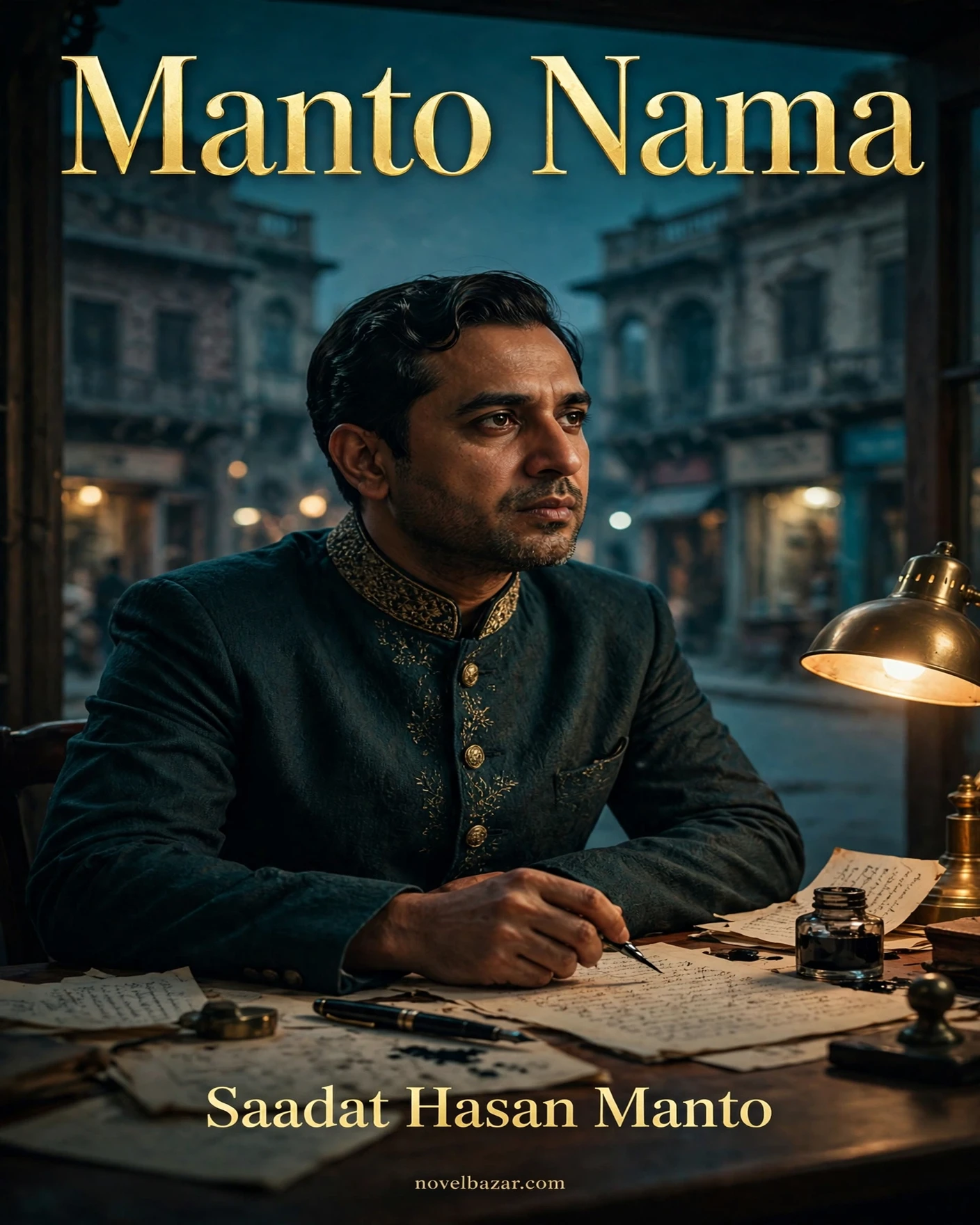
novelbazar.com
Quick Answer: Manto Nama is a collected volume of Saadat Hasan Manto’s Urdu short stories (Sang-e-Meel Publications, Lahore), not a single novel. On NovelBazar you can read it online and download the complete PDF using the buttons below.
✅ Complete PDF Download
Manto Nama by Saadat Hasan Manto: What Kind of Book Is It?
The first thing to get straight is the form. A novel follows one long story from beginning to end. Manto Nama does not. It is a book of short stories, each one complete in itself, each one built around ordinary people in extraordinary situations. You can read it from the first page to the last, or you can open it anywhere and read a single story in one sitting. That is exactly how Manto wrote: short, direct and finished in a few pages, with an ending that often lands like a sudden, quiet shock.
The name itself tells you what the book is. “Nama” here means a book or account, so Manto Nama is, in plain words, the book of Manto: a volume that gathers his stories together so that readers do not have to hunt through dozens of separate old collections. Library records describe it simply as a collection of Saadat Hasan Manto’s short stories, in Urdu, published by Sang-e-Meel. Goodreads’ Urdu description of the volume says it gathers the story collections Phundne, Yazid, Chughad, Thanda Gosht, Sarkandon Ke Peeche, Lazzat-e-Sang and Baghair Ijazat. That list matters, because it shows the book’s range: early work and later work, Bombay stories and Partition stories, side by side.
What Is Inside Manto Nama?
Because Manto Nama is a collected volume, its exact table of contents can differ a little from one Sang-e-Meel edition to another. Editions from 1990, 1995, 2007 and 2011 are all cited in catalogues and academic writing, so if your copy’s contents page looks slightly different from someone else’s, that is normal. It does not mean your copy is wrong. What stays constant is the kind of writing inside: short, realistic stories about people society usually looks away from.
Academic citations place several well-known pieces in Manto Nama, including “Thanda Gosht”, “Lazzat-e-Sang”, “Sau Candle Power ka Bulb” and “Gormukh Singh ki Waseeyat”. Around them sit the themes Manto returned to all his life: the madness and human cost of the Partition of 1947, the lives of sex workers, pimps, clerks, actors and labourers, the gap between what respectable society says and what it actually does, and the small dignities of people with almost nothing. Some descriptions of the volume also mention essays alongside the stories, which is why some readers describe it as stories and essays together. Either way, the stories are the heart of it.
Saadat Hasan Manto: The Writer Behind the Book
Saadat Hasan Manto was born on 11 May 1912 in Samrala, in the Ludhiana district of Punjab, and died in Lahore on 18 January 1955, aged only 42. In that short life he published 22 collections of short stories, one novel, five collections of radio plays, three collections of essays and two collections of personal sketches. He worked in Bombay’s film world and in radio, then migrated to Lahore in January 1948 after Partition, and it was in Lahore that he wrote many of his masterpieces.
Manto is famous for two things that go together: his honesty and his trouble with the law. He was tried for obscenity six times, three times before 1947 and three times after, and he was never convicted. His answer to his critics was, in effect, that he wrote about society as it was, not as it pretended to be. That is why his stories still feel modern: they refuse to flatter the reader. He was honoured after his death with the Nishan-e-Imtiaz in 2012, and Pakistan issued a commemorative postage stamp on the fiftieth anniversary of his death in 2005. Readers on Goodreads rate Manto Nama at about 4.4 out of 5.
Manto’s Writing Style: Why His Stories Hit So Hard
Manto’s style is the opposite of flowery. His sentences are short. His descriptions are spare. He does not explain his characters’ feelings at length; he shows one action, one line of dialogue, one detail, and lets the reader feel the rest. A story may be only a few pages long, yet readers remember it for years, because the ending reframes everything that came before it. Critics often call this his irony: the story seems to be about one thing, and in the last lines you realise it was about something else entirely.
His people are the second reason the stories last. Manto wrote about prostitutes, madmen, refugees, soldiers, clerks and film people, not as symbols but as individuals with humour, stubbornness and pride. He had little patience for communal hatred or for the hypocrisy of the respectable classes, and he wrote against both without preaching. That combination, plain language plus uncomfortable truth, is why students, writers and ordinary readers keep returning to him, and why his work is still debated in classrooms and literary circles.
How to Read Manto Nama for the First Time
If you are new to Manto, do not try to read the whole volume in one go. Read one story, put the book down, and think about its ending. Start with the famous Partition stories and the Bombay stories, then move to the quieter, stranger pieces. Because each story stands alone, there is no wrong order, and no plot you can spoil by dipping in. Students often find Manto useful for essays and exams precisely because each story gives them a complete example of theme, character and irony in a few pages.
One honest note for new readers: some of Manto’s stories deal frankly with adult subjects and with the violence of Partition. That frankness is the reason for his obscenity trials, and it is part of why the work matters, but younger readers may want to start with the less graphic stories and read the harder ones with a teacher or an elder. The book is serious literature, not light entertainment, and it is best read slowly.
Manto Nama, Manto Ke Afsanay and the English Collections: Do Not Mix Them Up
Search results mix several different Manto books together, so here is the separation. Manto Nama is the Urdu collected volume from Sang-e-Meel. Manto Ke Afsanay (1940) is a much earlier, separate collection, his second book of stories. The English books you will see, “Manto: Selected Short Stories” (translated by Aatish Taseer) and “Bitter Fruit: The Very Best of Saadat Hasan Manto” (Penguin), are translations and selections, not the Urdu Manto Nama. If you want Manto in his own Urdu, Manto Nama is the volume to look for. If you want him in English, the translations are excellent, but they are different books with different contents.
Key Facts
- Manto Nama is a collected volume of Urdu short stories, not a single novel.
- Author: Saadat Hasan Manto (1912-1955); publisher: Sang-e-Meel Publications, Lahore.
- It gathers collections including Phundne, Yazid, Chughad, Thanda Gosht, Sarkandon Ke Peeche, Lazzat-e-Sang and Baghair Ijazat; contents vary slightly by edition.
- Language: Urdu. English readers should look for the Selected Stories or Bitter Fruit translations instead.
- Themes: Partition, social hypocrisy, marginal lives, irony, human dignity.
- Goodreads rating: about 4.4 out of 5.
| Book Name | Manto Nama |
| Author/Writer Name | Saadat Hasan Manto |
| Genre | Urdu short stories, classic literature, Partition literature |
| Publisher | Sang-e-Meel Publications, Lahore |
| Status | Complete collected volume |
| Language | Urdu |
| Availability | Read Online and Complete PDF Download on NovelBazar |
| Book Name | Manto Nama |
| Writer | Saadat Hasan Manto |
| Genre | Short-story collection |
| Format | |
| Title Meaning | The Book of Manto: a collected volume of his writings |
| Common Theme | Truth-telling about Partition, society and its margins |
| Language | Urdu |
| Status | Complete |
| Reading Format | Read Online or Download PDF |
Download Manto Nama by Saadat Hasan Manto: Free PDF
Read or download Manto Nama by Saadat Hasan Manto in full. Use the buttons above: Read Online opens the book for reading, and Download PDF saves the complete PDF to your device.
If you enjoy classic Urdu literature, you may also like Raja Gidh by Bano Qudsia, Zindagi Gulzar Hai by Umera Ahmed and Peer e Kamil by Umera Ahmed, all available on NovelBazar.
Frequently Asked Questions
Is Manto Nama a novel?
No. Manto Nama is a collected volume of Saadat Hasan Manto’s Urdu short stories. It has no single hero or continuous plot; each story is complete on its own.
Who wrote Manto Nama?
Saadat Hasan Manto (1912-1955), one of the greatest Urdu short-story writers, wrote the stories collected in Manto Nama. Sang-e-Meel Publications, Lahore, publishes the volume.
What stories are inside Manto Nama?
It gathers earlier collections including Phundne, Yazid, Chughad, Thanda Gosht, Sarkandon Ke Peeche, Lazzat-e-Sang and Baghair Ijazat. Exact contents vary slightly by edition, so check your copy’s contents page.
Is Manto Nama in Urdu or English?
The original Manto Nama is in Urdu. English readers should look for “Manto: Selected Short Stories” or “Bitter Fruit”, which are translations and selections, not the same book.
Why was Manto controversial?
Manto wrote frankly about prostitution, Partition violence and social hypocrisy. He was tried for obscenity six times, three before 1947 and three after, and was never convicted.
Can I read Manto Nama online and download its PDF on NovelBazar?
Yes. Use the Read Online button to read it here, or the Download PDF button to save the complete PDF.