
Zaviya 3 by Ashfaq Ahmed – Complete PDF Download
novelbazar.com
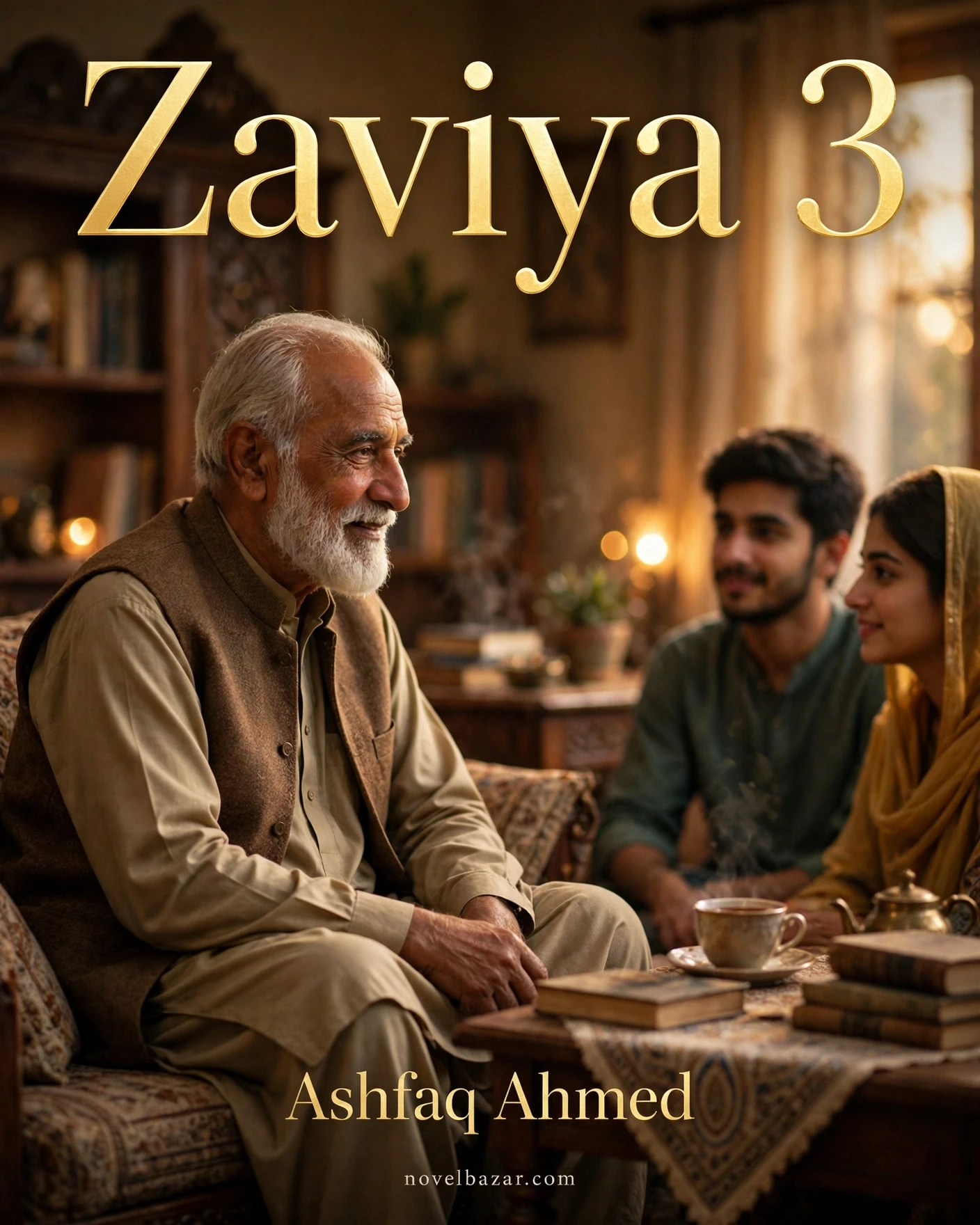
Zaviya 3 by Ashfaq Ahmed is the third volume of one of the most loved Urdu books of modern times, and this page gives you the complete volume to read online and download as a PDF, together with an honest guide to what the book actually is, how it came from television, and how best to read it.
If you came here expecting a romantic novel with a hero, a heroine and a love story, stop for a moment, because that expectation will mislead you.
Zaviya 3 is not a novel at all, and understanding its real form is the first step to enjoying it.
The book is a collection of essays, talks and reflections, written in Urdu, and it grew out of Ashfaq Ahmed’s famous Pakistan Television programme of the same name.
In that programme he sat with a live audience, mostly young people, and answered their questions about life, faith, society and the self, in simple, warm, everyday language.
This guide keeps every claim close to what the sources actually say, and it says plainly where the sources disagree, so you are never sold a confident story that the evidence does not support.
Quick Answer: Zaviya 3 (Urdu: زاویہ 3) is the third volume of Ashfaq Ahmed’s Zaviya series of essays and reflections, not a novel.
It collects his later television talks, in which he turns from everyday problems to deeper questions of grace, inner peace and surrender to the will of God, and it is best read one talk at a time, slowly, not finished in a single rush.
Key Facts
- Form: the third volume of a series of essays, talks and reflections (not a novel, not a short-story collection, and not a single continuous story).
- Author: Ashfaq Ahmed (1925 to 2004), Pakistani writer, playwright and broadcaster, lovingly remembered by readers as Baba Ashfaq.
- Origin: the Pakistan Television programme Zaviya, telecast from October 1998 to February 2004, in about 90 episodes.
- Programme format: Ashfaq Ahmed spoke first, for about twenty minutes, and then answered questions from the audience in the room.
- Title meaning: Zaviya means angle, perspective or dimension, the idea that life looks different when you look at it from a new angle.
- Language: Urdu, in the author’s own conversational style, mixing everyday speech with poetry, anecdote and Sufi wisdom.
- Place in the series: Volume 1 lays the foundations, Volume 2 turns outward to people and relationships, and Volume 3 turns inward to the spiritual life.
- Reading time: the volume suits slow, one-talk-at-a-time reading, and a single talk can be finished in one sitting.
| Book Name | Zaviya 3 (Urdu: زاویہ 3, also spelled Zavia 3, Zaviya III, Zawiya 3) |
| Author / Writer Name | Ashfaq Ahmed |
| Genre | Essays, reflections and spiritual talks |
| Form | Third volume of the Zaviya essay series, not a novel |
| Origin | PTV programme Zaviya, October 1998 to February 2004, about 90 episodes |
| First Published (as listed) | Catalogue listings differ on edition years; Rekhta lists Zaviya Volume 3 as 2006, so no single first-edition year is asserted here |
| Status | Complete third volume |
| Language | Urdu |
| Availability | Free PDF Download and Read Online |
\u2705 Complete PDF Download
Zaviya 3 by Ashfaq Ahmed: What the Book Actually Is
Zaviya 3 is a book of talks, not a tale.
There is no hero who falls in love, no villain who blocks his way, and no climax in which everything is resolved, because the book was never built that way.
Each piece in it began as a spoken answer, given in a room full of listeners, to a real question about real life.
That is why the book reads like a conversation rather than a story, and why it keeps working for readers who open it years after it was written.
A reader who picks it up looking for a novel will feel lost within a few pages, while a reader who picks it up looking for guidance will feel at home at once.
Readers who enjoy reflective Urdu writing in this mode often enjoy Dil Darya Samandar by Wasif Ali Wasif, another book of reflections that rewards the same slow, thoughtful reading, though its voice and subject are entirely its own.
The talks are short, plain and direct.
Ashfaq Ahmed does not lecture from a height, and he does not hide behind difficult words.
He tells a small story from his own life, or from someone he knew, and draws a simple lesson from it, the way an elder speaks to a younger person at home.
The humour is gentle, the tone is kind, and the hardest ideas are explained through ordinary things, a shopkeeper, a traveller, a neighbour, a prayer said late at night.
What Zaviya Means, and Why the Name Matters
The Urdu word Zaviya means an angle, a perspective, or a dimension.
Ashfaq Ahmed chose the word deliberately, because his whole method was to take a familiar problem and look at it from a fresh angle.
A quarrel, a failure at work, or a fear about the future all look different when the angle changes, and the book is a long practice in changing the angle.
That is also why the television programme worked so well.
A young person asked a question in one angle, and Ashfaq Ahmed answered from another, and suddenly the problem felt smaller, clearer and more bearable.
Once you understand the name, you understand the book, because every talk in it is one more angle on the same human life.
The name also explains why the series has three volumes instead of one.
One angle is never enough for a whole life, so the talks return to the same themes again and again, each time from a slightly different side.
Volume 3 is the angle of the later years, when the questions grow quieter and deeper, and the answers lean more on faith, patience and trust than on effort and planning.
Readers who love Urdu books that look at life from a new angle may also value Manto Nama by Saadat Hasan Manto, a very different kind of book, but one that likewise asks the reader to think again about familiar things.
Where Volume 3 Sits in the Zaviya Series
The Zaviya series has three volumes, and they form a natural journey.
Booksellers and readers describe the first volume as the foundation, where Ashfaq Ahmed encourages self-discovery, honesty with oneself, and finding happiness even when life does not go as planned.
The second volume turns outward, to communication, empathy and the way we treat the people around us, and it asks how a person can build kinder, more compassionate relationships.
The third volume turns inward again, but at a deeper level, to grace, inner peace and surrender to the will of God, and to accepting the challenges of life with patience instead of fighting every one of them.
You do not strictly need to read Volumes 1 and 2 before Volume 3, because each talk stands on its own.
A reader who opens Volume 3 first will still understand every piece, since no talk depends on an earlier talk for its meaning.
But the journey feels richer in order, because the reader grows with the books, from self-knowledge, to other people, to God and the inner life.
For readers who want a long, absorbing Urdu book after the reflections, Zarguzasht by Mushtaq Ahmad Yousufi is a famous humorous classic, though it belongs to a different mood altogether, and it should not be confused with the Zaviya talks.
Themes in Zaviya 3: What the Talks Keep Returning To
No single chapter list can be asserted for this volume from the sources available, and this guide invents none.
What booksellers, readers and programme descriptions agree on is the direction of the third volume, and that direction is clear enough to guide a new reader.
The talks return to the inner life, to the struggle with the ego, to small kindnesses, and to the peace that comes from wanting less and trusting more.
Grace, inner peace and surrender
The central theme of the third volume is surrender, not as defeat, but as trust.
Ashfaq Ahmed encourages the reader to accept that not everything in life can be controlled, planned or forced, and that peace begins when a person stops wrestling with what cannot be changed.
Grace, in these talks, is the quiet gift that arrives when a person does their best and then leaves the result to God.
This is the theme that makes Volume 3 the favourite of many older readers, who have already learned that effort alone does not settle a life.
The ego, humility and small kindnesses
Running beside surrender is a steady warning against the ego.
Ashfaq Ahmed returns to the harm done by pride, by the need to be right, and by the habit of measuring oneself against others.
His answer is always practical, never abstract.
Do a small kindness without telling anyone, forgive a small injury without keeping score, speak gently when you could speak harshly, and watch how the heart softens.
A reader who wants the same lesson in a grand historical setting may turn to Aangan by Khadija Mastoor, though its story and its world are far from the quiet rooms of the Zaviya talks.
Everyday life as the real spiritual ground
Nothing in Zaviya 3 floats away from daily life.
The talks stay close to the home, the workplace, the family table and the street, because Ashfaq Ahmed believed that character is proved in ordinary hours, not in grand moments.
A person who is patient with a difficult relative, honest in a small dealing, and grateful for a simple meal is already practising everything the book teaches.
It does not ask you to leave your life, it asks you to live the same life with a different angle.
Ashfaq Ahmed: The Man Behind the Talks
Ashfaq Ahmed was born on 22 August 1925 and died on 7 September 2004, and his life covered almost the whole story of Pakistan, from its birth to the new century.
He was a writer, a playwright and a broadcaster, and he worked for radio and television as well as for the printed page.
His other well known works include Gadariya, Mann Chale Ka Sauda and Aik Mohabbat Sau Afsane, and his long running radio programme Talqeen Shah made his voice familiar in homes across the country.
Readers called him Baba, an elder, and the name fits, because his manner was that of a wise, affectionate elder rather than a distant professor.
His authority came from experience, not from degrees alone.
He had travelled, taught, written plays, raised a family, and watched Pakistan change, and he spoke about all of it as someone who had lived it.
Young people trusted him because he listened before he answered, and never shamed the person who asked a painful question.
The Zaviya programme ran from October 1998 to February 2004, in about 90 episodes, and it was in those final years that his manner became most gentle and most Sufi in feeling.
Readers who want to know another great Urdu storyteller of the same generation may enjoy Khaak aur Khoon by Naseem Hijazi, a powerful historical novel, though it is fiction, and Zaviya 3 is not.
Zaviya 1, 2 and 3, and His Other Books: Do Not Confuse Them
Three confusions trap new readers, and all three are easy to avoid once they are named.
First, Zaviya 1, Zaviya 2 and Zaviya 3 are three separate volumes, and none of them replaces the others.
A file or a book that contains only the first volume is not the complete series, and a file that contains only the third volume is not the whole of Zaviya either.
Second, the television programme Baithak, the guest room, was a different programme from Zaviya, even though Ashfaq Ahmed appeared in both and both had the same warm, conversational feeling.
Third, his plays, short stories and other essay books, such as Baba Sahiba and Mehman Saraye, are separate works, and they should not be mixed into the Zaviya volumes.
A genuine Zaviya 3 file is a book of Urdu talks and reflections, presented as the third volume, and it does not read like a novel, a play or an autobiography.
If a file opens as a love story with a hero and a heroine, it is a different book wearing a similar name, and the reader should check the title page before going further.
The same caution applies to spelling.
Zaviya, Zavia, Zawiya and Zaavia are all spellings of the same Urdu word, and booksellers use them interchangeably, so search with more than one spelling if your first search finds nothing.
A short, tender Urdu book in a very different key is Maan Ji by Qudratullah Shahab, and comparing the two shows how wide Urdu writing really is, from a mother’s portrait to a sage’s talks.
How to Read Zaviya 3: A Simple Reading Order
Read one talk at a time, and give it a day to settle.
The talks are short, and it is tempting to rush through ten of them in an evening, but the book works better when a single talk is read slowly, twice if needed, and then carried into the next day.
Mark the one sentence in each talk that speaks to your own life at the moment, because that sentence is the real gift of the talk.
Read with someone else if you can.
The talks began as a conversation in a room, and they come alive again when they are discussed, with a friend, a parent, a teacher or a study circle.
A question that seems simple when read alone often opens up when another person answers it from their own angle, which is exactly the method of the book itself.
Students may also read the volume for essays and speeches, but they should quote it honestly, as a book of talks and reflections, never as a novel, and never with a plot summary it does not contain.
For a reflective book by another beloved Urdu voice, Ya Khuda by Qudratullah Shahab is a natural next step, and it rewards the same unhurried pace.
Who Should Read Zaviya 3, and Who Should Choose Something Else First
This volume is for readers who want calm, direction and meaning, rather than excitement.
It suits young people facing choices about study and work, parents raising children with patience, and older readers making peace with a long life.
It suits anyone who feels restless, angry or disappointed, and wants a wiser angle on the same troubles, without being preached at.
It also suits readers who loved Volumes 1 and 2 and want the journey to its quiet conclusion.
It is not the right first choice for a reader who wants a fast romantic novel, a thriller, or a historical epic, and such a reader will only be disappointed by a book of talks.
It is also not a textbook of religion, and it should not be read as a book of formal religious rulings.
Its wisdom is Sufi in feeling and moral in aim, but it speaks as a thoughtful elder, not as a scholar issuing verdicts.
A reader who wants a novel should choose a novel, and return to Zaviya 3 when the need is for reflection rather than story.
That reader may enjoy Kulliyat-e-Iqbal by Muhammad Iqbal first, and come back to Zaviya 3 later, when a quieter book is what the heart wants.
How to Read Online and Download the Zaviya 3 PDF
Use the buttons on this page to read Zaviya 3 online or to download the complete PDF.
The Read Online button opens the volume for reading in your browser, and the Download PDF button saves the complete third volume to your device for offline reading.
Both buttons use the same complete file, so choose whichever suits your reading habit, and keep the file for re-reading, because this is a book that improves on a second visit.
A genuine Zaviya 3 file is an Urdu book of talks and reflections, presented as the third volume of the series, and any file that opens as a romantic novel is a different book.
Page counts and edition years vary between printings, so do not judge a file by those numbers alone.
Zaviya 3 by Ashfaq Ahmed: Frequently Asked Questions
Is Zaviya 3 a novel?
No, Zaviya 3 is not a novel.
It is the third volume of a series of essays, talks and reflections by Ashfaq Ahmed, and it has no plot, no hero and no heroine.
It grew out of his PTV programme of the same name, in which he answered the audience’s questions about life, faith and society.
What does Zaviya mean?
Zaviya means angle, perspective or dimension.
The title describes the book’s method, which is to look at a familiar problem from a fresh angle, so that it feels clearer and more bearable.
Every talk in the volume is one more angle on human life.
Who wrote Zaviya 3?
Zaviya 3 was written by Ashfaq Ahmed, the Pakistani writer, playwright and broadcaster who lived from 1925 to 2004.
He is lovingly remembered as Baba Ashfaq, and his other well known works include Gadariya, Mann Chale Ka Sauda and Aik Mohabbat Sau Afsane.
Is Zaviya 3 the third part of a series?
Yes, Zaviya 3 is the third of three volumes.
Volume 1 lays the foundations of self-discovery, Volume 2 turns to people and relationships, and Volume 3 turns inward to grace, inner peace and surrender to the will of God.
Each talk stands on its own, so Volume 3 can be read first, but the journey feels richer in order.
Do I need to read Zaviya 1 and 2 before Zaviya 3?
No, you do not need to, because each talk is complete in itself.
Nothing in Volume 3 depends on an earlier volume for its meaning.
Readers who have read the first two volumes will still enjoy Volume 3 more, because they arrive with the earlier lessons already in mind.
What is Zaviya 3 about?
Zaviya 3 is about the inner life in later years, about grace, patience, humility and trust.
Its talks return to the ego, to small kindnesses, to accepting what cannot be changed, and to finding peace by wanting less and trusting more.
No chapter list is asserted here, because the sources available do not agree on one, and this guide invents none.
When was the Zaviya television programme shown?
The PTV programme Zaviya ran from October 1998 to February 2004, in about 90 episodes.
In each episode he spoke for about twenty minutes and then answered questions from the audience.
The three books are the written form of those talks.
When was Zaviya 3 first published?
Catalogue listings differ on edition years, so no single first-edition year is asserted here.
Rekhta lists Zaviya Volume 3 as 2006, while other listings give different years for different volumes and editions.
Readers should check the title page of their own edition for its printing details.
How many pages is Zaviya 3?
Page counts vary between editions and printings, so no single page count is asserted here.
Printed volumes in the series are commonly described as modest, readable books of a few hundred pages, but the exact count depends on the edition.
The PDF on this page is the complete third volume, whatever its pagination.
Is Zaviya 3 in Urdu or English?
Zaviya 3 is an Urdu book, and the talks were delivered in Ashfaq Ahmed’s own conversational Urdu.
Readers looking for an English version should check the edition before buying or downloading, because this page’s file is the Urdu volume.
Is Zaviya 3 a religious book?
Zaviya 3 is spiritual and moral in feeling, with a Sufi warmth, but it is not a textbook of formal religious rulings.
It speaks as a thoughtful elder about faith, character and daily life, and it suits readers of any background who want honest moral reflection.
How can I read or download the complete Zaviya 3 PDF?
Use the Read Online and Download PDF buttons on this page.
The Read Online button opens the volume in your browser, and the Download PDF button saves the complete third volume for offline reading.
Both buttons use the same complete file, and no registration is required.
What should I read after Zaviya 3?
After Zaviya 3, many readers return to Volumes 1 and 2, or move on to Ashfaq Ahmed’s other essay books, such as Baba Sahiba and Mehman Saraye.
Whatever you choose next, keep the habit the book teaches, which is to read slowly, and to live what you read.
Read it slowly, one talk at a time, and let each talk leave its one clear sentence behind.
That is the reading the book asks for, and it is the reading it repays.
\u2705 Complete PDF Download
