
Yousuf bin Tashfin by Naseem Hijazi – Complete PDF Download
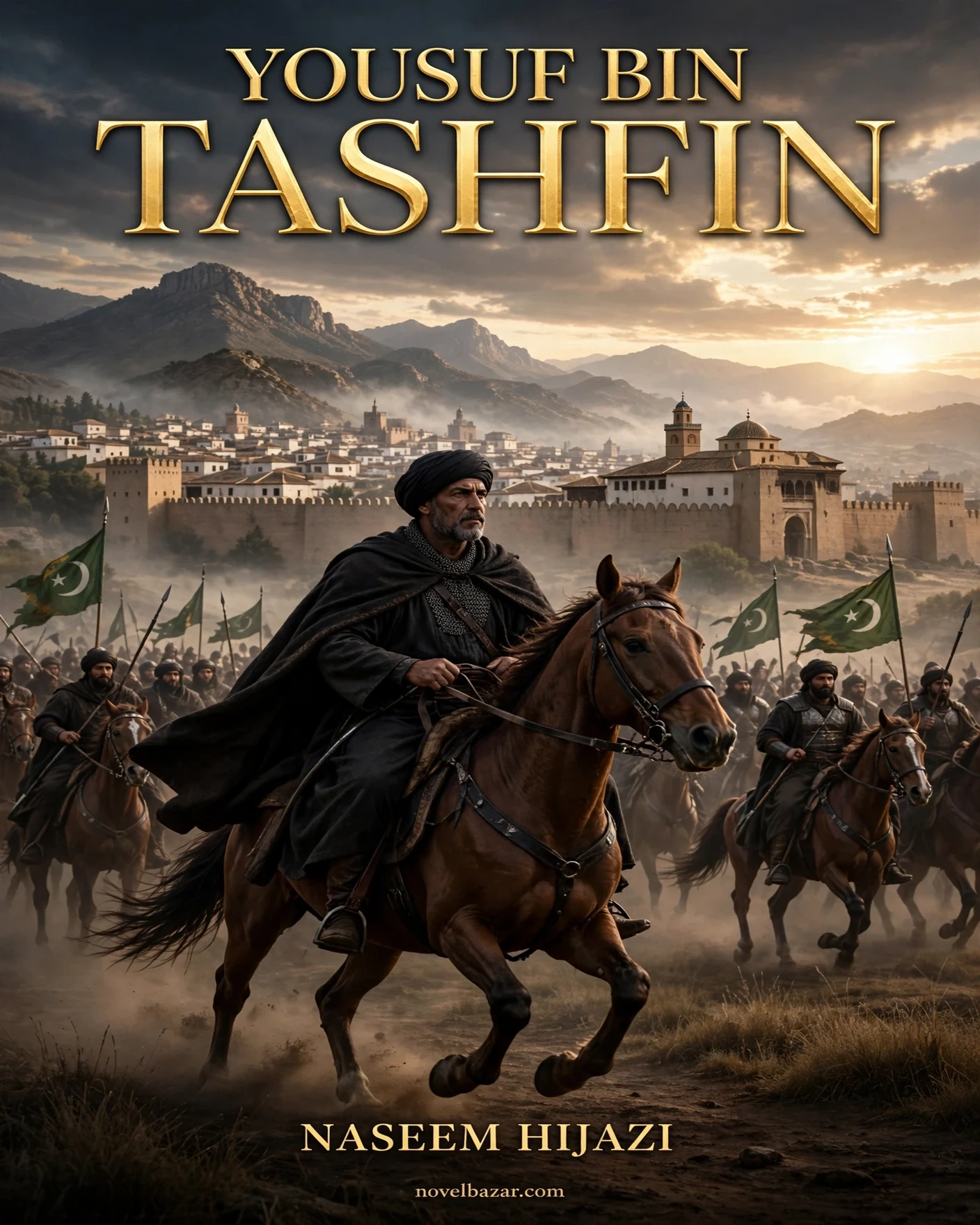
novelbazar.com
Yousuf bin Tashfin by Naseem Hijazi is a historical Urdu novel about one of the great turning points in the history of Muslim Spain, and this page gives you the complete novel to read online and download as a PDF, together with an honest guide to what it actually is, what period it covers, and why readers still search for it today.
Before you download anything, one fact matters more than any other.
This is not a love story.
There is no romantic hero and heroine at the centre of the book, no love triangle to follow, and no romantic ending to spoil.
Yousuf bin Tashfin is a historical novel about a ruler, a divided Muslim Spain, a call for help from across the sea, and a battle that held back the Reconquista.
This page therefore tells it plainly, right at the start, so that no reader opens the book expecting a romance and finds a battlefield and a throne room instead.
The title itself tells you the subject.
Yousuf bin Tashfin, also written Yusuf ibn Tashfin and Yusuf bin Tashfeen, was the Almoravid ruler of North Africa who crossed into Al-Andalus, Muslim Spain, in the eleventh century.
The spelling of his name changes from book to book, and this page uses the form in its title while noting the other common forms.
The novel covers the age when Muslim Spain was broken into small rival kingdoms, the taifas, while Alfonso VI of Castile pressed south, took Toledo, and demanded tribute from Muslim rulers who could no longer resist him alone.
The taifa rulers, above all al-Mutamid ibn Abbad of Seville, called on Yousuf bin Tashfin for help, and that call is the heart of this book.
If you love Islamic history, or want to read Naseem Hijazi’s Spanish novels in their historical order, then you have found exactly the right book.
Quick Answer: Yousuf bin Tashfin by Naseem Hijazi is a complete historical Urdu novel about the Almoravid ruler Yusuf ibn Tashfin, called from North Africa to rescue divided Al-Andalus, who defeated Alfonso VI of Castile at the Battle of Zallaqa (Sagrajas) on 23 October 1086. It is about leadership, unity, faith and empire, not romance. Read it online or download the complete PDF using the buttons on this page.
Key Facts
- Book: Yousuf bin Tashfin, Urdu title یوسف بن تاشفین, also written Yusuf ibn Tashfin and Yusuf bin Tashfeen.
- Author: Naseem Hijazi, the pen name of Sharif Hussain (1914 to 1996).
- Genre: historical novel, not a romance novel and not a love story.
- Historical figure: Yusuf ibn Tashfin, Almoravid ruler, reigned about 1061 to 1106.
- Historical setting: North Africa and Al-Andalus (Muslim Spain) in the eleventh century, the First Taifas period and the Spanish Reconquista.
- Central event: the Battle of Zallaqa (Sagrajas), 23 October 1086, near Badajoz, against Alfonso VI of Castile.
- Other key figure: al-Mutamid ibn Abbad, ruler of the taifa of Seville, who called on Yousuf for help.
- Reference tables list 7 editions of this novel.
- Language: Urdu, in Hijazi’s direct and stirring narrative style.
- Availability: complete PDF download and read online on this page.
| Novel Details | Information |
|---|---|
| Novel Name | Yousuf bin Tashfin |
| Author Name | Naseem Hijazi (Sharif Hussain) |
| Novel Genre | Historical, Islamic history, Al-Andalus, war and leadership |
| Historical Period | Eleventh century, First Taifas period, Almoravid Empire, Spanish Reconquista |
| Main Places | Marrakech and North Africa, Seville, Badajoz and Al-Andalus |
| Central Figure | Yusuf ibn Tashfin, Almoravid ruler (reigned about 1061 to 1106) |
| Central Event | Battle of Zallaqa (Sagrajas), 23 October 1086 |
| Other Key Figures | Alfonso VI of Castile, al-Mutamid ibn Abbad of Seville |
| Novel Status | ✅ Complete |
| Language | Urdu |
| Availability | Free PDF Download and Read Online |
What Kind of Book Is Yousuf bin Tashfin?
Yousuf bin Tashfin is a historical novel.
That single sentence is the most important thing on this page, because the book is sometimes sold with nothing more than a short shop description, a price, and a list of themes, and a reader can easily come away knowing the hero’s name without knowing what kind of story he is about to read.
So let us be exact: this book belongs with historical novels about the rise and fall of Muslim rule in Spain, and with stories of leadership in a time of division.
It does not belong with romantic novels, and this page does not pretend otherwise.
A historical novel is not a history textbook, and it is not a romance either.
It takes real history as its background and real rulers and battles as its anchors, and then tells a story inside that history so that the reader feels the age rather than merely memorising its dates.
Hijazi was a master of exactly this form.
Yousuf bin Tashfin Story Overview
The novel tells, at theme level, the story of a rescue that became an empire.
Muslim Spain, Al-Andalus, had broken apart after the fall of the Umayyad caliphate of Cordoba.
In place of one strong state there were many small taifa kingdoms, each ruled by its own prince and each too weak, alone, to face the Christian kingdoms in the north.
That fragmentation is the starting point of the book.
The pressure came from Alfonso VI, king of Leon and Castile, who had taken Toledo in 1085.
The taifa rulers were paying him tribute, money paid to a stronger neighbour in return for peace, while watching their independence drain away year by year.
The most famous of those rulers was al-Mutamid ibn Abbad of Seville, a prince remembered as much for poetry and court life as for politics, and it was he, with other taifa rulers, who sent the call across the Strait of Gibraltar to North Africa.
They asked Yousuf bin Tashfin, the Almoravid ruler in Marrakech, to come and defend them.
Yousuf answered the call.
He crossed from Africa into Spain, joined forces with the Andalusi rulers, and met Alfonso VI at Zallaqa, near Badajoz, on 23 October 1086.
The battle ended in a decisive Muslim victory, Alfonso himself was wounded, and the Christian advance into Muslim Spain was halted for a generation.
The battlefield took the Arabic name az-Zallaqah, meaning slippery ground, and the battle is known in European histories as Sagrajas.
That victory is the centre of the novel, and of Yousuf’s historical reputation: the man who saved Al-Andalus when it could no longer save itself.
But the story does not end at Zallaqa, and an honest summary must say so.
After the victory Yousuf returned to North Africa, and when he came back he found the taifa rulers still divided, still quarrelling, and still unable to defend themselves.
Gradually, with the support of religious scholars, he removed the taifa rulers from power one by one and united Al-Andalus under Almoravid rule.
That second half of the story is harder than the first, because the invited rescuer became the new ruler, and the princes who had called him lost their thrones.
Readers who want to see how Hijazi handles a different age of division and endurance can turn to Khaak aur Khoon by Naseem Hijazi, although that book tells its story on a different scale from the kings and armies of this one.
The Historical Setting: Divided Spain and the Almoravid North
To understand this novel, you need two paragraphs of history, and these are they.
First, Al-Andalus in the eleventh century was no longer the great caliphate of Cordoba.
It was a patchwork of taifas, small kingdoms centred on cities such as Seville, Badajoz, Granada and Malaga, rich in poetry and learning but weak in war, because each prince watched his fellow princes as much as the enemy in the north.
Tribute bought time, but it also bought dependence.
Second, across the strait in North Africa, a very different kind of movement had grown up.
The Almoravids, al-Murabitun in Arabic, began as a reform movement among the Sanhaja Berbers of the Sahara, founded on religious discipline, simple living and strict observance, and under Yousuf bin Tashfin that movement had become an empire.
Yousuf, a Sanhaja leader who had succeeded his cousin Abu Bakr ibn Umar, built Marrakech as his capital and extended his rule across North Africa before he ever set foot in Spain.
When the call came from Andalus, therefore, it was not a wandering adventurer who answered, but the ruler of a disciplined, expanding state.
Who Was Yousuf ibn Tashfin?
Yusuf ibn Tashfin, in the standard historical spelling, was a Sanhaja Berber leader and the ruler of the Almoravid Empire, reigning from about 1061 until his death in 1106.
He is commonly described as born around 1009, which would make him a very old man at his death, and the sources differ on his exact age, so this page gives the approximate birth year only and asserts no precise age.
He co-founded Marrakech, made it his capital, and took the title Amir al-Muslimin, Commander of the Muslims, a title that marked him as a ruler who claimed religious, not merely political, authority.
Chroniclers describe him as just, devout and simple in his personal life, and credit his wife Zaynab al-Nafzawiyya with a real part in his rise.
His son and successor was Ali ibn Yusuf, under whom the empire reached its greatest extent before its later decline under the Almohads.
Two warnings belong here, because popular retellings often smooth them away.
First, the sizes of the armies at Zallaqa are given very differently by different sources, and some popular articles give neat figures for ships and soldiers that no scholarly source confirms in that form.
This page therefore asserts no army size, no ship count and no casualty total for the battle.
What is certain, and what every source agrees on, is the date, the place, the commanders, the outcome, and the wound Alfonso carried for the rest of his life.
Second, Yousuf is not a hero without shadows in the history books.
European histories remember him, in the El Cid tradition, as the formidable enemy from Africa, while Muslim histories remember him as the saviour of Andalus.
Hijazi’s novel tells the story from the Muslim side, and this page says so openly.
Main Themes in Yousuf bin Tashfin
Unity against fragmentation.
This is the first and largest theme of the book, and it is stated in almost every description of it, because it is the whole plot in one word.
Divided, the taifas paid tribute and lost ground year by year, while united, under one command, they won at Zallaqa and held Spain for generations more.
Hijazi returns to this theme again and again: a community that quarrels among itself cannot defend itself against anyone else.
The same question, what faith demands of a person when the world around him falls apart, is asked in a very different key in Jab Zindagi Shuru Hogi by Abu Yahya, although that modern Islamic novel approaches faith through the life to come, while Yousuf bin Tashfin approaches it through the battlefield and the throne room of this world.
Leadership as service, not luxury.
The second theme is the character of the leader himself.
Yousuf is presented, in both the histories and the novel’s tradition, as a man of simple habits, prayer, justice and consultation with scholars, set against taifa princes famous for poetry, music and extravagant courts.
The contrast is Hijazi’s moral argument in story form: a ruler is judged by his justice and his discipline, not by the splendour of his palace.
Rescue, and its price.
The hardest theme is the one the book cannot avoid: the rescuer stayed.
The taifa rulers asked for an army and received a new sovereign, and the Andalusians, who had welcomed deliverance, found themselves governed from Marrakech, by men whose desert discipline felt foreign in the courts of Seville and Cordoba.
That tension, gratitude mixed with resentment, is what makes the story more than a simple victory tale.
A different lens on a community in decline, unsparing and poetic rather than stirring, can be found in Musaddas-e-Hali by Altaf Hussain Hali, where Hali mourns a community that has lost its strength and calls it to wake up, while Hijazi here shows a community being given, for a time, a second chance.
About the Author: Naseem Hijazi and His Spanish Novels
Naseem Hijazi was the pen name of Sharif Hussain, born on 19 May 1914 in Sujaanpur near Dhariwal in the Gurdaspur district of Punjab, before Partition.
He became one of the most widely read Urdu novelists of Pakistan, a journalist as well as a novelist, who specialised in Islamic history as the material for his fiction.
His family migrated to Pakistan at independence, and he died on 2 March 1996 in Rawalpindi.
In 1992 he received the Pride of Performance Award.
To place this book correctly among Hijazi’s works, remember the map of his career.
His earliest historical novel, Daastaan-e-Mujahid by Naseem Hijazi, deals with the first Muslim conquests under the Umayyads, centuries before Yousuf.
His Spanish novels, including Yousuf bin Tashfin, Shaheen, Kaleesa Aur Aag and Andheri Raat Ke Musafir, deal with the later story of Muslim Spain: first its rescue under the Almoravids, then its long decline and final fall.
Shaheen, for example, deals with the fall of Granada in 1492, four centuries after Zallaqa, and it is a different book from Yousuf bin Tashfin, and the two should never be confused.
His Partition novel, Khaak aur Khoon by Naseem Hijazi, deals with the violence and upheaval of 1947, a completely different age from eleventh-century Spain.
Read the Hijazi map in historical order, from the early conquests, to the Almoravid rescue, to the fall of Granada, and the whole arc becomes clear, with Yousuf bin Tashfin as its middle, hopeful chapter.
Readers who want to hear longing, memory and resolve in verse rather than in prose can turn to Bang-e-Dara by Muhammad Iqbal, where the same feelings sound as poetry.
Hijazi turned such feelings into stories, and Yousuf bin Tashfin is one of his fullest stories of a leader who answered them.
Who Should Read Yousuf bin Tashfin?
This book is for you if you love Islamic history and want to feel it as a story rather than study it as a list of dates.
It is for students who want a first, stirring introduction to Al-Andalus and the Reconquista before they tackle a formal history.
It is for readers of Hijazi who want the middle chapter of his Spanish story.
It is for parents and teachers looking for a book that gives young readers a hero of faith, justice and discipline.
And it is for anyone who has ever wondered how a divided people can be saved, and what saving them costs.
This book is probably not for you if you are looking for a romance, a family saga, or a light novel to read in one sitting without thinking.
It is not a comedy, and it is not a thriller in the modern sense, although its battles and councils carry plenty of tension.
Readers who want a love story should choose a romantic novel instead, and this site carries many, including Bano by Razia Butt, which gives the emotional, personal side of life that Yousuf bin Tashfin deliberately leaves aside.
Knowing what a book is not is part of choosing well, and this page would rather lose a download than mislead a reader.
How to Read This Novel Honestly
Read it first as a story, and let it move you.
Hijazi wrote to stir the heart, and there is nothing wrong with letting a good story do its work.
Notice what he values in his ruler: faith, obedience, courage, justice, loyalty to comrades, and simplicity in victory.
Those values are the novel’s real argument, and they are worth thinking about long after the last page.
Then read it a second time, in your head, as history, and ask the harder questions.
Was the rescue worth its price, and did unity under Marrakech save Andalus or merely postpone its fall?
Hijazi moulded history to fit his plots, as the newspaper Dawn observed of his work in general, and some historians accuse him of distorting historical facts.
Read Yousuf bin Tashfin for its story and its moral vision, and then check the history itself in a general history of the Almoravids and the Reconquista.
After a serious historical novel, many readers want something lighter, and Zarguzasht by Mushtaq Ahmad Yousufi offers exactly that change of mood, humour and satire from a master of Urdu wit.
Frequently Asked Questions About Yousuf bin Tashfin
Final Verdict: Should You Read Yousuf bin Tashfin?
Yes, if you want a historical novel rather than a romance, and if you want to meet Naseem Hijazi in his Spanish mode.
Yousuf bin Tashfin is not a light book, because it is about a divided people, a hard choice, and a victory that carried its own price.
That seriousness is why readers still search for it and recommend it to the next generation.
Readers who finish it and want to follow the Spanish story to its end should read Hijazi’s Shaheen next, and readers who want another powerful story from the same tradition should turn to Aangan by Khadija Mastoor.


