
Khushbu by Parveen Shakir – Complete PDF Download
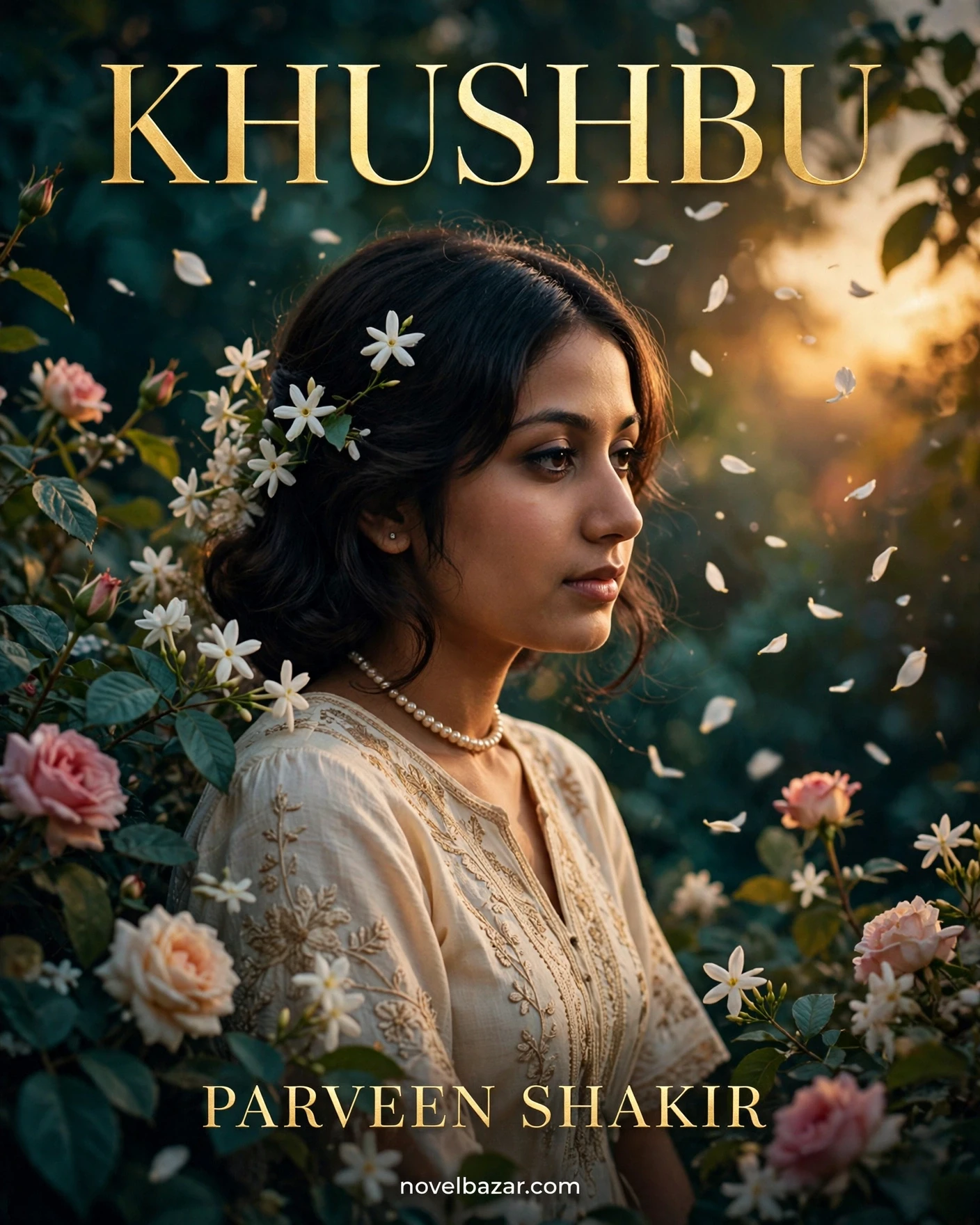
novelbazar.com
Khushbu by Parveen Shakir is one of the most loved first books in Urdu poetry, and this page gives you the complete book to read online and download as a PDF, together with an honest guide to what the book actually is, what it contains, and why readers have kept returning to it for fifty years.
Before you download anything, one fact matters more than any other.
This is not a novel.
There is no hero waiting in the next chapter, no love story unfolding toward a climax, and no plot twist to spoil.
Khushbu, published in 1976, is Parveen Shakir’s debut collection of poetry, a book of ghazals and free verse written when she was only twenty three years old, and it changed Urdu poetry by giving it a new, clear, feminine voice.
Readers search for this book under several spellings, including Khushboo and Khusboo, and all of them point to the same first collection by the same poet.
Quick Answer: Khushbu by Parveen Shakir is the poet’s debut Urdu poetry collection from 1976, made up of ghazals and free verse on love, longing, identity, and everyday life. It has no plot and no characters, because it is poetry, not a story. Read it online or download the complete PDF using the buttons on this page.
Key Facts
- Form: a debut collection of Urdu poetry, ghazals and free verse, not a novel.
- Author: Parveen Shakir (1952 to 1994), Urdu poet, teacher, and civil servant.
- First published: 1976, to great acclaim, when the poet was twenty three.
- Title meaning: Khushbu means fragrance, the scent that cannot be seen or held, but fills every place it reaches.
- Award: the collection won the Adamjee Literary Award in 1976.
- Language: Urdu, in a famously simple, musical, and accessible style.
- Best way to read: a few poems at a time, slowly, and aloud when you can.
- Availability: complete PDF download and read online on this page.
| Book Name | Khushbu (Fragrance) |
| Author Name | Parveen Shakir |
| Book Form | Poetry collection: ghazals and free verse, not a novel |
| First Published | 1976 |
| Language | Urdu |
| Award | Adamjee Literary Award, 1976 |
| Author Born | 24 November 1952, Karachi |
| Status | Complete book |
| Availability | Free PDF Download and Read Online |
Khushbu by Parveen Shakir: What This Book Really Is
Khushbu is a book of poems, and it helps to say plainly what that means for a reader who has come here expecting a novel.
A novel follows people through events, but a poetry collection follows feelings through images.
Each ghazal in Khushbu is complete in itself, made of couplets that can be read on their own, and each free verse poem is a single moment held still long enough to look at properly.
There is no heroine whose fate you follow from chapter to chapter, and there is no ending that resolves a story, because there is no story to resolve.
What you follow instead is a voice, young, honest, and observant, speaking about love and separation, about waiting and remembering, and about being a woman with her own thoughts in a world that often asked women to stay quiet.
That is exactly why the book became famous, and why it is still read today.
What Does Khushbu Mean? The Fragrance That Cannot Be Held
Khushbu is the Urdu word for fragrance, the scent of a flower, of rain on dry earth, of a person who has just left the room.
It is a perfect title for this book, because fragrance is the one thing you cannot catch or keep.
You cannot lock it in a drawer, and you cannot make it stay, and yet it changes the whole atmosphere of a place while it is there.
Parveen Shakir builds her poems around this image again and again.
Love, in Khushbu, behaves like fragrance.
It arrives without permission, it cannot be owned or fenced in, and it lingers after the moment itself has gone.
The same image carries a second meaning, which is why the title has lasted so long.
A young woman poet in 1976, writing openly about her own feelings, was herself something that could not be kept inside the usual boundaries.
Her voice travelled, like fragrance, far beyond the room it started in, and it reached readers who had never heard a woman speak this plainly in Urdu poetry before.
What Is Inside Khushbu? Ghazals, Free Verse, and Themes
The poetry in Khushbu falls into two forms, and knowing the difference makes the book much easier to enjoy.
The first form is the ghazal, the classical Urdu form made of couplets, usually five to ten in a single ghazal, linked by rhyme and refrain but each couplet able to stand on its own.
A ghazal does not tell a story from start to finish, and that is not a flaw.
It is a string of separate, polished moments on one mood, and the reader is free to pause on any couplet that speaks to them and skip past one that does not.
The second form is free verse, called nazm in Urdu, where the poet is not bound by the strict rhyme and metre of the ghazal and can let a thought run as long as it needs to.
Parveen Shakir uses both forms with equal confidence, and the mix is part of the book’s charm.
The ghazals give the book its music, and the free verse gives it room to breathe and to describe ordinary life in detail.
The themes of the book are love and longing first, but they are never only that.
Separation and waiting run through the poems, and so does memory, the way a scent or a sound can bring back a person who is no longer there.
There is also a strong theme of identity, of a woman asking who she is apart from the roles other people have given her.
Everyday life appears constantly, in small, concrete images drawn from flowers, rain, breeze, evenings, and ordinary rooms, rather than in grand, abstract language.
That closeness to daily life is one reason the poems feel so personal, and it is why readers often say the poems sound like their own thoughts, said better.
The Feminine Voice That Changed Urdu Poetry
To understand why Khushbu mattered in 1976, it helps to know what Urdu poetry sounded like before it.
The ghazal had been, for centuries, a form in which men mostly wrote, often in a masculine voice, about an absent or distant beloved.
Parveen Shakir wrote as a woman, in a woman’s voice, about her own feelings, and she did it without apology and without hiding behind heavy, formal language.
That directness was new, and readers noticed it at once.
She wrote about love from the side of the person who waits, hopes, and remembers, and she wrote about it in the language of everyday speech, softened and shaped into poetry.
Young women readers in particular found, for the first time, poems that sounded like their own inner lives.
It made Parveen Shakir a public figure, invited to mushairas and literary gatherings across the country, and it made her, as one profile put it, a celebrity of Urdu letters while she was still in her twenties.
Later collections deepened the voice that Khushbu introduced, but they did not replace it.
For most readers, Khushbu remains the place where that voice first appears in its freshest and most open form, and it is still the best starting point for anyone new to her work.
Readers who love strong heroines in classic Urdu fiction may also enjoy the very different, but equally memorable, central woman of Aangan by Khadija Mastoor, a novel where a woman’s inner life carries the whole story, though in prose rather than poetry.
About the Author: Parveen Shakir (1952 to 1994)
Parveen Shakir was born on 24 November 1952 in Karachi, and she began writing at an early age, first contributing poems to newspapers and magazines while she was still a teenager.
In her earliest years as a writer she used the pen name Beena, before publishing under her own name.
She studied English literature and linguistics at the University of Karachi, earning master’s degrees in both subjects, and she then taught for nine years, including time at Karachi University and at Trinity College in Connecticut in the United States.
Teaching, however, was only the first of her two careers.
In 1982 she qualified for the Central Superior Services examination, joined the Civil Service of Pakistan, and served in the Customs department, rising to become second secretary of the Central Board of Revenue in Islamabad in 1986.
She later earned a further master’s degree in public administration in 1991.
The combination is worth pausing on, because it explains something about the poems.
Here was a poet who spent her working days inside government offices and her writing life inside the most private feelings, and the poems keep both worlds in balance.
Khushbu was published in 1976, while she was still a young teacher, and it won the Adamjee Literary Award the same year.
She later received the Pride of Performance, one of Pakistan’s highest honours for contribution to literature, though published sources disagree on the year of that award, and this page does not present a single year as settled fact.
Her life was cut short on 26 December 1994, when she died in a car accident in Islamabad on her way to work, at the age of forty two.
She left behind a son, and a body of work that has only grown in reputation since her death.
A trust in her name now works to preserve her poetry, and her books remain in print and in demand nearly fifty years after Khushbu first appeared.
Khushbu and Parveen Shakir’s Other Books
Khushbu was only the beginning, and readers who love it usually want to know what came next.
Her second collection, Sad-barg, appeared in 1980, and two more collections, Khud Kalami and Inkar, followed in 1990.
A later collection, Kaf-e-Aina, and a volume of her newspaper columns, Gosha-e-Chashm, complete the picture of a writer who worked in both poetry and prose.
Most of her poetry books were later gathered into the collected volume Mah-e-Tamaam, with the exception of Kaf-e-Aina, which is a useful fact for a reader shopping for a collected edition.
None of these later books replaces Khushbu, and none of them should be confused with it.
Each collection has its own mood, and Khushbu keeps the special quality of a first book, the excitement of a new voice discovering what it can do.
If you are buying or downloading, check the title carefully, because the names are sometimes spelled differently in different listings.
Khushbu, Khushboo, and Khusboo are the same first collection, but Sad-barg, Khud Kalami, Inkar, and Kaf-e-Aina are different books, and a file labelled with one of those names is not Khushbu.
Other writers have used the word Khushbu in their own titles, including novels with no connection to Parveen Shakir, and those books are different works by different authors.
This page is about Parveen Shakir’s 1976 poetry collection only.
For a taste of classic Urdu prose from the same literary world, Manto Nama by Saadat Hasan Manto gathers the sharp, unforgettable short fiction of another giant of Urdu letters, and reading the two side by side shows how wide Urdu writing really is.
Who Should Read Khushbu? And How to Read It
Khushbu suits almost any reader who has ever loved a poem, and it suits several kinds of reader in particular.
It suits the new reader of Urdu poetry, because the language is clear and the poems are short enough to finish in a sitting.
It suits the reader who already loves ghazals, because these are ghazals written with unusual freshness and honesty.
It suits students and teachers of Urdu literature, because the book is a landmark that is discussed in every serious account of modern Urdu poetry.
The way to read it matters as much as the decision to read it.
Do not try to finish it like a novel, cover to cover in one night.
Read three or four poems, then put the book down and let them settle.
Read a ghazal aloud if you can, because Urdu poetry is written for the ear as much as for the eye, and a couplet that looks plain on the page often opens up when it is heard.
Keep a pencil nearby, and mark the couplets you want to return to, because you will return to them.
Many readers keep Khushbu by the bed or on a phone, dipping into it the way other people dip into a book of prayers or proverbs, one piece at a time.
Readers who enjoy dipping into short, wise pieces will find a similar pleasure, in prose rather than verse, in Zarguzasht by Mushtaq Ahmad Yousufi, where humour and observation do the same work of holding a single moment up to the light.
Why Khushbu Still Matters Today
Fifty years after 1976, Khushbu has not faded, and there are clear reasons for that.
The first reason is the voice itself, which still sounds modern because it is direct.
Poetry that hides behind decoration ages quickly, but poetry that says a true thing plainly stays readable, and Khushbu says true things plainly.
The second reason is the theme, because love, waiting, memory, and identity have not gone out of date.
Every new generation of young readers finds its own feelings already described in these poems, and that discovery is what turns a reader into a lifelong admirer.
The third reason is the book’s place in literary history, since Khushbu is now taught, quoted, and celebrated as the book that brought a new feminine voice into the centre of Urdu poetry.
How to Read Khushbu Online and Download the Complete PDF
This page provides the complete book for reading online and for PDF download, so you can choose whichever way suits you.
Reading online is best if you want to start at once, on a phone or a computer, without saving anything.
Downloading the PDF is best if you want to keep the book, read it offline, or return to your favourite poems again and again.
Both buttons point to the same complete book file supplied for this page.
If you are new to Urdu poetry, start with the ghazals, read slowly, and do not worry about understanding every word on the first pass.
If you are comparing editions, remember that page counts differ between printings and layouts, so a listing that shows one page count and another listing that shows a different one are usually describing different editions of the same book, not different books.
What matters is that the file you open is the complete 1976 collection by Parveen Shakir, under the title Khushbu.
Frequently Asked Questions About Khushbu
Is Khushbu by Parveen Shakir a novel?
No, and this is the most important thing to know before you start. Khushbu is a collection of poems, ghazals and free verse, first published in 1976. It has no plot, no hero, and no heroine, because it is poetry, not a story. Readers who come looking for a novel will still enjoy it, but they should expect poems, not chapters of a tale.
Who wrote Khushbu, and when was it published?
Khushbu was written by the Pakistani Urdu poet Parveen Shakir and first published in 1976, when she was twenty three years old. It was her debut book, and it won the Adamjee Literary Award in the same year.
What does the title Khushbu mean?
Khushbu means fragrance in Urdu. The title points to the book’s central image, love and feeling as a scent that cannot be seen or held, but fills every place it reaches and lingers after the moment has passed.
Is Khushbu a book of ghazals or nazms?
It is both. The collection contains ghazals, the classical couplet form of Urdu poetry, and free verse poems, called nazms, in which the poet is not bound by strict rhyme and metre. The mix of the two forms is part of the book’s character.
Does Khushbu have a hero or a heroine or a story?
No. A poetry collection has no characters and no storyline. The poems speak in a personal voice about love, longing, separation, memory, and identity, but they do not follow invented people through events the way a novel does.
Are Sad-barg, Khud Kalami, Inkar, and Kaf-e-Aina the same book as Khushbu?
No. Those are Parveen Shakir’s later, separate poetry collections. Sad-barg appeared in 1980, Khud Kalami and Inkar in 1990, and Kaf-e-Aina later still. Only Khushbu is her 1976 debut collection, so check the title before you download.
Are other books called Khushbu the same book?
Not necessarily. Other writers have used the word Khushbu in their own titles, including novels that have no connection to Parveen Shakir. This page is about Parveen Shakir’s 1976 poetry collection only, so always check the author’s name as well as the title.
Why is Khushbu sometimes spelled Khushboo or Khusboo?
Those are simply different roman spellings of the same Urdu word, and different sellers, apps, and listings use different spellings. Khushbu, Khushboo, and Khusboo, when they name Parveen Shakir’s book, all refer to the same 1976 collection.
How many pages does Khushbu have?
That depends on the edition. Different printings and PDF layouts of the same book show different page counts, so this page does not present a single page count as a fixed fact. What matters is that the file is the complete collection, not a selection of a few poems.
When did Parveen Shakir receive the Pride of Performance?
She received the Pride of Performance, one of Pakistan’s highest honours for literature, after Khushbu’s success, but published sources disagree on the year, with some giving 1976 and others 1990. This page therefore does not assert a single year for that award as settled fact. The Adamjee Literary Award for Khushbu itself, in 1976, is consistently reported.
How can I read Khushbu online or download the complete PDF?
Use the Read Online and Download PDF buttons on this page. They point to the complete book file supplied for this page, so you can read at once in your browser or save the PDF for offline reading.
What should I read first if I am new to Parveen Shakir?
Start with Khushbu itself. It is short, clear, and written in accessible Urdu, and it introduces the voice that runs through all her later work. Read a few poems at a time, aloud when you can, and move on to Sad-barg afterwards if you want more.
What should I read after Khushbu?
For more Urdu poetry, go on to Sad-barg, her second collection. For classic Urdu prose that shows a different side of the same literary tradition, readers often turn next to Aangan by Khadija Mastoor or to Khaak aur Khoon by Naseem Hijazi, though both are novels, not poetry, and should be read with that difference in mind.
Final Verdict: Should You Read Khushbu?
Khushbu by Parveen Shakir earns its place among the most loved Urdu books not by telling a story but by saying, beautifully and plainly, what it feels like to love, to wait, and to remember.
It does not demand weeks of your time or a background in literary theory.
It asks only for a few quiet minutes and an honest heart, and it repays that small attention many times over.
Read it in the morning before the world gets loud, or at night before sleep, and let one poem do its work before you reach for the next.
Read the complete book online or download the complete PDF using the buttons on this page, and start with any poem that catches your eye.
And when you want words on love and feeling in a modern, contemporary voice after Parveen Shakir’s timeless poems, Dil Se Niklay Hain Jo Lafz by Farhat Ishtiaq offers a modern collection of words on love and emotion, written in a very different time but for the same searching heart.