
Mazeed Hamaqatain by Shafiq ur Rahman – Complete PDF Download
novelbazar.com
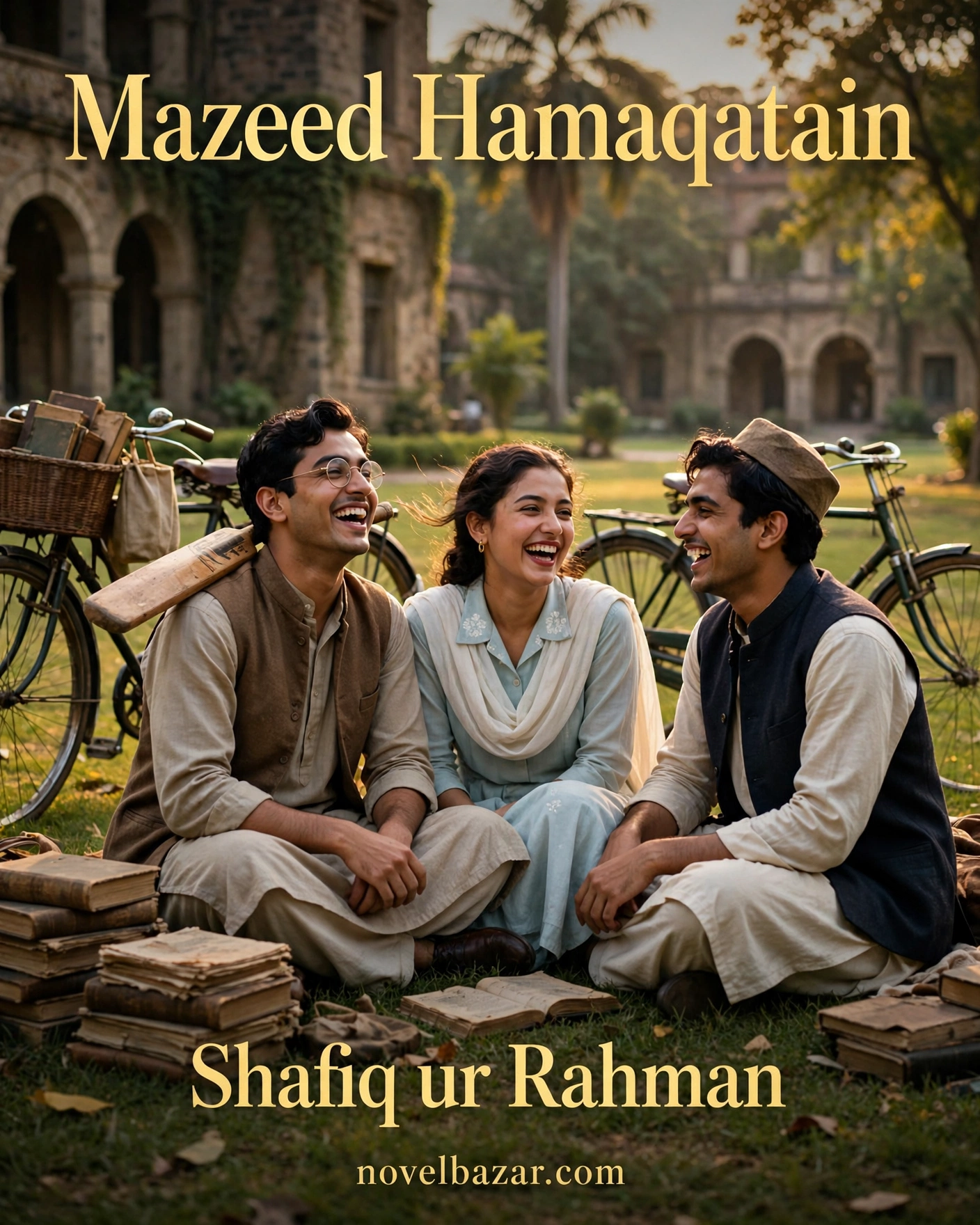
Mazeed Hamaqatain by Shafiq ur Rahman is one of the most loved humorous books in Urdu, and this page gives you the complete book to read online and download as a PDF, together with the author proof, the essays inside it, and the reading guidance that other download pages leave out or get wrong.
It is a collection of humorous essays and short pieces, a sequel to the author’s earlier collection Hamaqatain, and it has made Urdu readers laugh for generations with its jokes, its wordplay, and its very human view of everyday foolishness.
The first thing to know is the author, because this book is often credited to the wrong writer.
Mazeed Hamaqatain was written by Shafiq ur Rahman, the Pakistani humorist and short story writer, and not by Mushtaq Ahmed Yusufi.
The proof is set out plainly in the author section below, with book listings and bibliographies, so that no reader has to take the credit on trust.
Quick Answer: Mazeed Hamaqatain by Shafiq ur Rahman is a complete humorous essay collection in Urdu, the sequel to Hamaqatain (1947). It is not a novel or a romance, and it is not by Mushtaq Ahmed Yusufi. Read it online or download the complete PDF using the buttons below.
Key Facts
- Title meaning: More Follies, the sequel to Hamaqatain (1947).
- Author: Shafiq ur Rahman, not Mushtaq Ahmed Yusufi (proof in the article).
- Form: humorous essays and short pieces, each complete on its own.
- Famous figure: Shaitaan (Roofi), the mischief maker.
- First-edition year: disputed between sources (1948 vs 1954), asserted as neither.
- Genre warning: a humour collection, not a romantic novel.
| Novel Name | Mazeed Hamaqatain |
| Author / Writer Name | Shafiq ur Rahman |
| Genre | Humorous essays and short pieces (not a novel, not a romance) |
| First Published | Sequel to Hamaqatain (1947); first-edition year disputed (1948 vs 1954, see article) |
| Status | Complete book |
| Language | Urdu |
| Availability | Free PDF Download and Read Online |
| Print Edition | Sang-e-Meel hardcover, listed 287 pages, ISBN 9789693512274 |
✅ Complete PDF Download
Mazeed Hamaqatain by Shafiq ur Rahman: What This Book Really Is
Mazeed Hamaqatain is a book of humorous essays in Urdu.
The word Mazeed means more or further, and Hamaqatain means follies or foolish acts, so the title reads in English as More Follies.
It is the second helping of the follies that Shafiq ur Rahman began collecting in Hamaqatain, and the title itself is a joke in the author’s own style, a cheerful admission that human foolishness never runs out.
Do not shelve this book with romantic novels, and do not read it expecting a story with chapters that build to a climax.
Its unit is the essay and the short humorous piece, not the chapter of a novel.
Readers who enjoy collections of short pieces often enjoy other classic collections too, and one famous example on this site is Manto Nama by Saadat Hasan Manto.
The comparison is useful, because it shows how different two Urdu masters can be while working in short forms.
Where Manto shocks and unsettles, Shafiq ur Rahman charms and teases, and both kinds of writing have earned their place in Urdu literature.
The Title, Explained: Why More Follies
Hamaqatain, the first collection, appeared in 1947, and its success is the whole reason a Mazeed, a more, was needed.
Readers wanted more of the same jokes, the same characters, and the same gentle mockery of ordinary life, and the author obliged with a second collection.
The title therefore tells you two facts at once: this book continues an earlier book, and its subject is human folly, treated with affection rather than cruelty.
A note on spelling will save readers some confusion in search results.
You will see the book written as Mazeed Hamaqatain, Mazeed Himaqatain, Mazeed Hamaqtain, and in Urdu as مزید حماقتیں.
The Author Question, Settled: Shafiq ur Rahman, Not Mushtaq Ahmed Yusufi
This section matters, because the wrong author credit for this book is common, and a download page that gets the author wrong cannot be trusted on anything else.
Mazeed Hamaqatain is by Shafiq ur Rahman, and the evidence is direct, from several independent kinds of source.
Book listings for the Sang-e-Meel edition credit Mazeed Hamaqatain to Shafiq ur Rahman, with ISBN 9789693512274, and reader catalogues such as Goodreads list the same book, with the same ISBN, under Shafiq ur Rahman, with a reader rating of 4.23 from 221 ratings.
Biographical sources agree, and they place the book inside Shafiq ur Rahman’s own bibliography.
His biographical entry lists Himaqatain in 1947 and Mazeed Himaqatain soon after it, among his early books, between Parwaz and his long later silence, and literary profiles of the author discuss Himaqatain and Mazeed Himaqatain together as his comedic marvels.
No biographical source for Shafiq ur Rahman omits these books, and no catalogue places them under another name.
The Yusufi confusion is understandable, and it is worth explaining rather than merely dismissing.
Mushtaq Ahmed Yusufi was also a great Urdu humorist, and the two men are often named together as the twin peaks of modern Urdu humour, alongside Patras Bukhari.
But Yusufi’s famous books are different books entirely, and his best known humorous collection in this very publishing program is Zarguzasht by Mushtaq Ahmed Yusufi, a work of satirical sketches about a family, not the Hamaqatain books.
Yusufi’s bibliography makes the point conclusively, because it has no room for Mazeed Hamaqatain in it.
His celebrated works are Chiragh Talay, Khakam Badahan, Zarguzasht, Aab-e-Gum, and Sham-e-Shair-e-Yaaran, and every obituary and reference profile of Yusufi lists those titles and never the Hamaqatain books.
The two humorists shared an era and a gift, but they did not share this book, and this page credits it to its true author.
One honest uncertainty remains, and this page does not hide it.
Reference sources disagree on the first publication year of Mazeed Hamaqatain, with some giving 1948, immediately after Hamaqatain, and the biographical entry’s main text giving 1954.
This page therefore does not assert a single first-edition year as fact, and says only that the book followed Hamaqatain (1947) as its sequel, while the current Sang-e-Meel hardcover is listed at 287 pages.
What Is Inside Mazeed Hamaqatain
Because this is an essay collection, there is no single story summary to give, and any page that invents one is inventing, not summarising.
What can honestly be described is the shape of the book: a run of humorous pieces, each complete in itself, held together by the author’s voice, his recurring characters, and his view of ordinary life.
That shape is the book’s identity, and readers who understand it before they start enjoy it far more than readers who keep waiting for a plot to arrive.
The contents reported for this collection include pieces whose titles alone give a flavour of the humour.
Among them are Shaitan, Ainak aur Mausam-e-Bahar, a piece built around the author’s famous mischief maker Shaitaan, glasses, and the spring season, and Taxila se Pehle, Taxila ke Baad, a before and after piece set around Taxila.
Other reported contents include Zanana Urdu Khat-o-Kitabat, on women’s Urdu letter writing, Safarnama Jahaz Bad Sindhi ka, a travel piece, and Barsati, the raincoat travelogue that literary profiles call one of the author’s best stories.
Still other reported contents show the author’s range, from the historical fancy of Tazk-e-Nadiri urf Siyahat Nama-e-Hind, to the domestic comedy of Yeh Radio Room Tha, to Kaleed-e-Kamyabi, to Mulki Parinday aur Doosray Janwar, on local birds and other animals, and two poems grouped as Do Nazmain.
Contents can vary slightly between editions, so this page presents these titles as the contents reported for the collection, not as a guarantee for every printing.
The Humour: How Shafiq ur Rahman Makes You Laugh
Shafiq ur Rahman’s humour works by wit and repartee rather than by slapstick.
Literary profiles make this exact distinction, noting that his wit put him ahead of contemporaries who depended more on playfulness or situational comedy.
His essays are often described as collections of jokes held together by the essay itself as a thread, and that description fits Mazeed Hamaqatain well, because the jokes arrive inside sentences, conversations, and asides, not as separate punchlines.
The prose itself is part of the pleasure, and readers say so in their reviews.
Reviewers of the Hamaqatain books praise the elegant, lyrical prose in some passages, passages worth reading again and again, alongside the love, the cricket, the nature, and the observations on life.
One honest reviewer note is worth repeating too: at times the book meanders, and the essays wander as essays do, and readers who accept that wandering enjoy the book most.
The People in His World: Shaitaan, Razia and Company
Shafiq ur Rahman’s stories are remembered for their people as much as for their jokes, and several characters recur across his books.
The most famous is Shaitaan, also written Roofi or Rufi, the mischief maker whose nickname says everything about him, and who appears in pieces across the author’s work, including the Mazeed Hamaqatain piece Shaitan, Ainak aur Mausam-e-Bahar.
Around the narrator stand other recurring figures, and literary profiles list them together.
Razia, a strong minded and witty young woman who profiles describe as a pillar of feminist strength, is among the closest figures to the narrator, along with Shaitaan and Bari Aapa.
Other recurring names in the author’s world include Maqsood Ghora, Hukoomat Aapa, Buddy, and Judge Sahab, and the narrator himself is usually an unnamed young man, able at sports and sound in intellect, through whose eyes the folly is seen.
Two cautions keep this section honest, and honest pages are more useful than confident ones.
First, these characters recur across Shafiq ur Rahman’s books as a whole, and this page does not claim that every one of them appears in Mazeed Hamaqatain in particular, except where a piece title proves it, as with Shaitaan.
Second, the author wrote mostly of youth and adolescence, so the world of these essays is a young world, full of friends, colleges, games, and first encounters with adult life, and that youthfulness is a large part of their lasting charm.
Hamaqatain vs Mazeed Hamaqatain: Which One First
Read Hamaqatain first, and Mazeed Hamaqatain second, because that is the order in which they were written and the order their titles promise.
Hamaqatain, published in 1947, introduced the author’s follies, his characters, and his voice, and Mazeed Hamaqatain, its sequel, gives readers more of the same, with the confidence of an author who knows his audience is already laughing.
Neither book depends on the other for understanding, since every essay stands alone, but reading them in order lets you watch the author’s humour grow surer.
The two books are often sold and searched together, and many listings, apps, and reader shelves carry both titles under Shafiq ur Rahman’s name.
That pairing is correct, and it is another useful author test: if a listing credits one Hamaqatain book to Shafiq ur Rahman and the other to someone else, the listing is wrong about one of them.
Both volumes belong to the same author, the same project, and the same joke, that human folly deserves a second volume.
About the Author: Shafiq ur Rahman (1920 to 2000)
Shafiq ur Rahman, born on 9 November 1920 and died on 19 March 2000, was a Pakistani humorist and short story writer of Urdu, and one of the most illustrious writers of the Urdu speaking world.
He began writing humorous stories in his school days, publishing in the literary monthly Khayyam, and he completed his first book, Kirnein, while still a medical student, before joining medical college life fully.
By profession he was a medical doctor, and after the independence of Pakistan in 1947 he joined the Pakistan Army, where he rose to high rank, eventually to general.
He later served as chairman of the Academy of Letters of Pakistan in the 1980s, and he received the Hilal-i-Imtiaz for his military and civilian services.
His early books came fast, and their dates trace the making of a humorist.
Kirnein appeared in the early 1940s, Shagufay in 1943, Lehrein in 1944, and Parwaz in 1945, and it was Lehrein and Parwaz that established him as a pure humorist, after the quasi romantic and quasi humorous stories of his first book.
Hamaqatain in 1947 and Mazeed Hamaqatain soon after it earned him still more acclaim, and together they fixed his reputation for good.
His place in Urdu literature is secure, and the comparisons made for him show how high that place is.
He is compared by readers and critics to Mark Twain and Stephen Leacock among world humorists, and to Patras Bukhari and Mushtaq Ahmed Yusufi among Urdu humorists, and his work is said to have added a new dimension to humour in Urdu literature.
One reviewer’s honest verdict is worth quoting in spirit: the Hamaqatain books may not be placed by every reader at par with Patras or Yusufi, but they certainly have their place among the finest works of humour in Urdu, and Mazeed Hamaqatain is a large part of that place.
The same generation of readers that laughed at Shafiq ur Rahman also read the great novels of the era, and the literary world of that time was a shared one.
A reader who finishes these essays and wants a full length classic from the same broad era of Urdu writing will find a very different kind of masterpiece in Aangan by Khadija Mastoor.
The contrast teaches something useful: Urdu literature of the period could do both, the lightest comedy and the most serious family saga, and both are worth a reader’s time.
Why Mazeed Hamaqatain Is Still Read Today
A humour book survives only if its jokes survive their own time, and Mazeed Hamaqatain has passed that test for three generations.
School and college readers discovered it, then their children discovered it, and now new readers discover it in PDF form, and the reason is that its subjects have not dated.
Exams, journeys, friendships, letters, games, and family elders are still with us, and the author’s way of looking at them still feels fresh, because it is based on observation, not on the fashions of any one decade.
The book’s afterlife in reader ratings supports all of this, and numbers, used carefully, are useful evidence.
Goodreads lists Mazeed Hamaqatain at 4.23 from 221 ratings, and its predecessor Hamaqatain at 4.21 from 646 ratings, which shows a steady, affectionate readership rather than a passing fashion.
Its place among the books of its time is part of the story too, and readers who want to understand the period will read widely.
The Partition era produced very different books side by side, from light humour to grave historical fiction, and a serious reader of the period often pairs a humour collection with a historical novel such as Khaak aur Khoon by Naseem Hijazi.
Read together, the two kinds of book give a fuller picture of a generation than either could give alone.
Who Should Read It, and Who Should Not Expect a Novel
This book is for readers who want to laugh, readers who love Urdu humour, students of Urdu literature, and anyone who wants a light book that is also a well written book.
It suits young readers, it suits readers returning to Urdu after a gap, and it suits busy readers, because every essay is short, complete, and satisfying on its own.
It is not for readers who want a romantic novel, a love story with a hero and a heroine, or a long plot with suspense and a climax.
Those readers will be disappointed, and the disappointment will be the fault of the listing, not of the book, which never promised to be a novel.
This page therefore says the genre plainly in its title table, in its headings, and in its answers, so that every reader arrives with the right expectation.
A practical reading tip will help first time readers more than any further praise.
Start with the shortest pieces, and with the pieces whose titles attract you, such as the Shaitaan piece or the Barsati travelogue, and do not feel obliged to read in order.
How to Read Mazeed Hamaqatain Online and Download the Complete PDF
Use the buttons on this page to read Mazeed Hamaqatain online or download the complete PDF.
The buttons point to the full book file supplied for this page, so you can start reading at once on a phone or a computer, and keep the PDF for offline reading later.
A note on the many copies circulating online will save readers time and confusion.
Several free listings carry only selections, or carry the first Hamaqatain volume under the second volume’s name, or carry no real text behind a download button at all.
Check before you download that the copy you open is credited to Shafiq ur Rahman, that it is the Mazeed volume rather than the first Hamaqatain volume, and that it is complete, and the version linked from this page is presented on exactly that basis.
If you finish these essays and want a full length story next, rather than another essay collection, this site has you covered.
A good next step for a reader in a story mood is Dil Se Niklay Hain Jo Lafz by Farhat Ishtiaq, a complete and much loved work that gives you the long, continuous narrative that an essay collection deliberately does not.
Alternating between a humour collection and a full length story is, in fact, one of the most enjoyable ways to read Urdu literature, and this page is built to make that alternation easy.
Frequently Asked Questions About Mazeed Hamaqatain
Who wrote Mazeed Hamaqatain?
Shafiq ur Rahman, the Pakistani humorist and short story writer (1920 to 2000). It is not by Mushtaq Ahmed Yusufi, whose famous books are Chiragh Talay, Khakam Badahan, Zarguzasht, Aab-e-Gum, and Sham-e-Shair-e-Yaaran.
What does Mazeed Hamaqatain mean?
Mazeed means more or further, and Hamaqatain means follies or foolish acts, so the title means More Follies. It is the sequel to Hamaqatain.
Is Mazeed Hamaqatain a novel?
No. It is a collection of humorous essays and short humorous pieces, not a novel and not a romance. Each essay stands on its own, with no single plot running through the book.
Is Mazeed Hamaqatain a romantic book?
No. It contains light touches of youth, friendship, and affection, but its genre is humour. Readers looking for a romantic novel should choose a different book on this site.
What is the difference between Hamaqatain and Mazeed Hamaqatain?
Hamaqatain (1947) is the first collection, and Mazeed Hamaqatain is its sequel, giving readers more of the same humour, characters, and voice. Read the first volume first, though each essay stands alone.
When was Mazeed Hamaqatain first published?
Sources disagree: some give 1948, others 1954. This page asserts neither year. The Sang-e-Meel hardcover is listed at 287 pages, ISBN 9789693512274.
Who are the characters in Mazeed Hamaqatain?
Recurring figures include Shaitaan (Roofi), Razia, Bari Aapa, Maqsood Ghora, Buddy, and Judge Sahab, seen through an unnamed young narrator. Shaitaan is directly attested in this volume by Shaitan, Ainak aur Mausam-e-Bahar.
What essays are in Mazeed Hamaqatain?
Reported contents include Shaitan, Ainak aur Mausam-e-Bahar, Taxila se Pehle, Taxila ke Baad, Zanana Urdu Khat-o-Kitabat, Safarnama Jahaz Bad Sindhi ka, and Barsati. Contents vary slightly between editions.
How can I read Mazeed Hamaqatain online or download the PDF?
Use the Read Online and Download PDF buttons on this page. They point to the complete book file supplied for this page, for online reading and for offline PDF reading.
Is Mazeed Hamaqatain good for new readers of Urdu humour?
Yes. It is one of the best introductions to Urdu humour, alongside Patras Bukhari and Yusufi. Start with any short essay, and read one piece at a time.
Final Verdict: Should You Read Mazeed Hamaqatain?
Mazeed Hamaqatain by Shafiq ur Rahman earns its place on every serious list of Urdu humour because it does something rare: it stays funny long after its own time has passed.
The jokes are built on observation, the characters are affectionately drawn, and the prose is elegant enough to reward rereading, which is why readers rate it warmly decades after publication.
Read it with the right expectation, and it will not disappoint you.
Do not open it looking for a novel, and do not open it looking for a romance.
Open it looking for a few minutes of laughter, a familiar world seen a little more clearly, and a master humorist at his early best, and that is exactly what you will find.
Read the complete book online or download the complete PDF using the buttons on this page, and start with any essay whose title makes you smile.
That smile is the author’s promise, and across a whole second volume of follies, it is a promise he keeps.


